What Is Symbolism?
Symbolism is the art of saying more than words can say: a simple image, object or gesture opens onto a whole world of meaning. Where does this language come from? Why do traditions as different as alchemy, Kabbalah and Freemasonry all speak through symbols? And how can symbols help us know ourselves today?
Symbolically, the same image can speak of danger and of healing, of an ending and of a beginning.
Symbolism is the common language of the great esoteric traditions of the West, and of every religion and mythology. Alchemy speaks in colors, Kabbalah in letters and numbers, tarot in images, astrology in planets and signs, Freemasonry in the tools of the builder.
A symbol is not a code with a single answer. A road sign means one thing; a symbol keeps opening new meanings as we live with it. This is why symbols matter for anyone who wants to know themselves and understand the world: they speak to the whole person, not only to reason.
This article belongs to the Symbolism section of the Wisdom & Spirituality door; the psychological reading of symbols is explored in the Consciousness & Psychology door. Let us look at symbolism from five angles.
Where does symbolism come from?
The word comes from the Greek symbolon, a token broken in two. Two friends, or two parties to an agreement, each kept one half; years later, fitting the halves together proved who they were. In this first sense, a symbol is something incomplete that finds its meaning when it meets its missing part.
Humans made symbols long before they wrote: cave paintings, burial offerings, carved spirals. Every religion and every body of myth then built its own language of images. In the Middle Ages, Christian scholars read nature itself as a book written by God, in which each animal, plant and stone carried a lesson. The Renaissance revived this taste with emblem books, which paired an image with a short motto and a poem.
From the seventeenth century, Freemasonry added a new chapter. The lodges of cathedral builders began to admit members who did not work stone, and in 1717 four London lodges formed the first Grand Lodge. The tools of the trade became symbols of moral and inner work.
What do symbols mean?
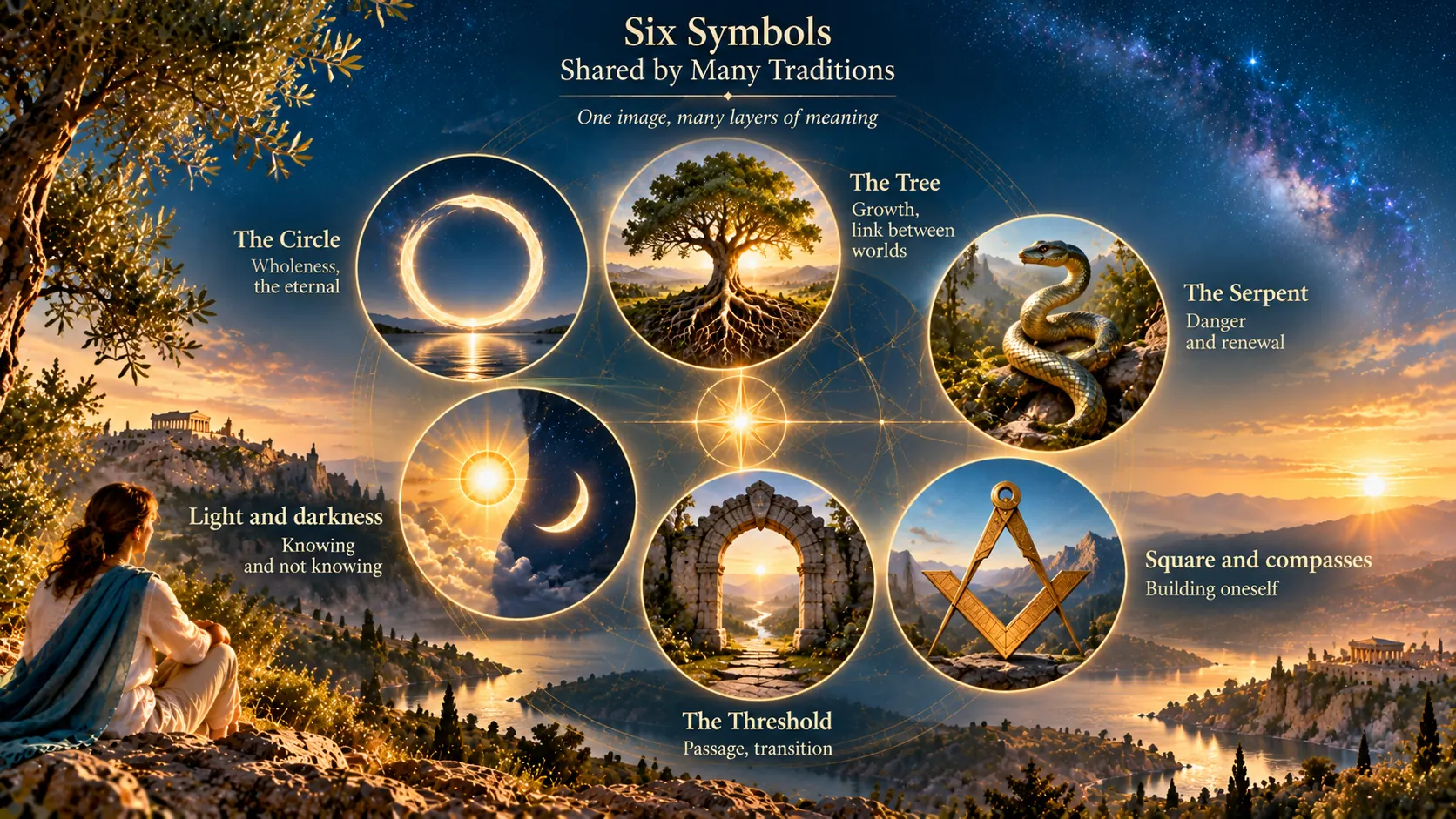
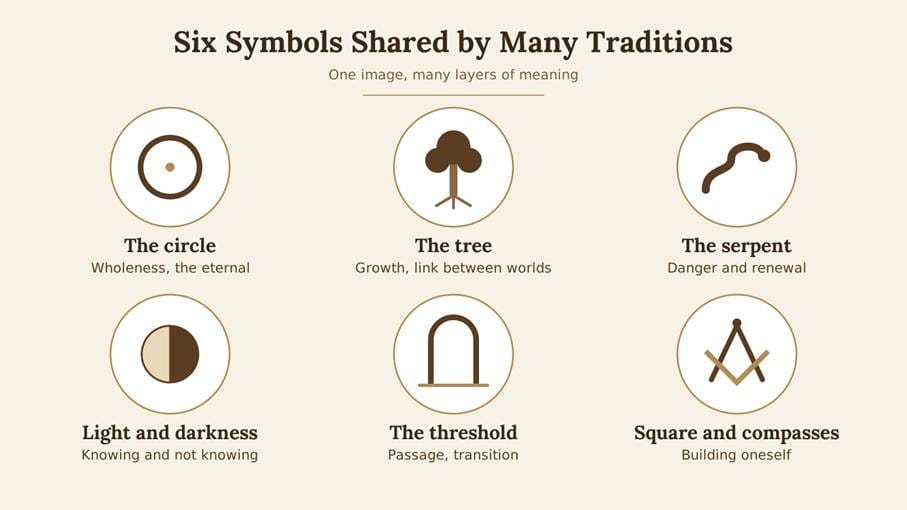
Symbolically, one image can hold several meanings at once, even opposite ones. This is what distinguishes a symbol from a sign. A few examples recur across many cultures:
- The circle: wholeness and eternity, with no beginning and no end.
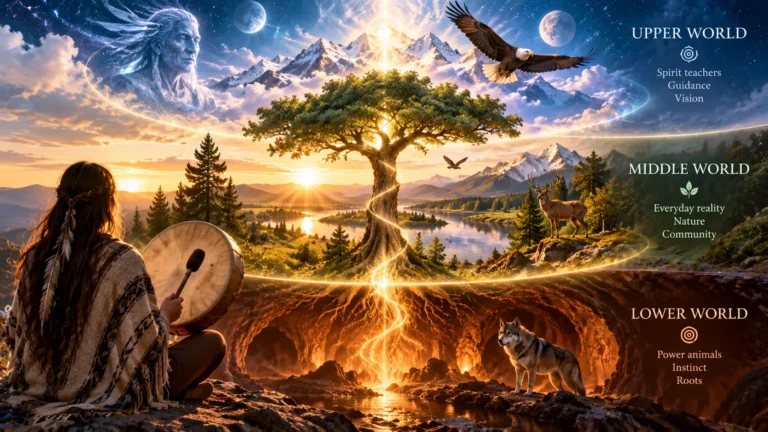
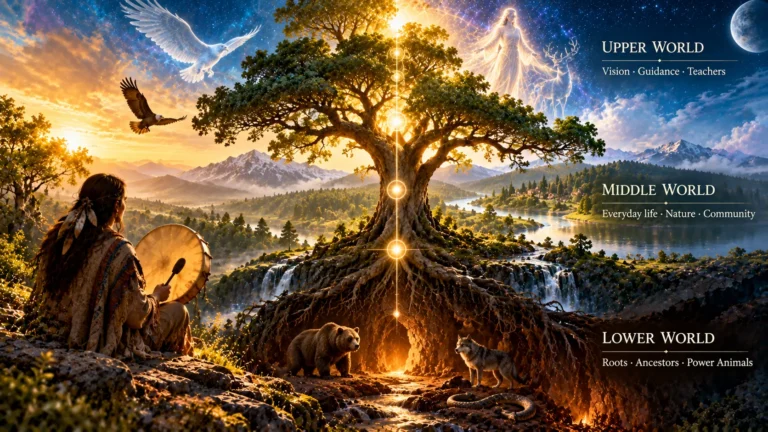
- The tree: growth, and the link between earth and sky through its roots and branches.
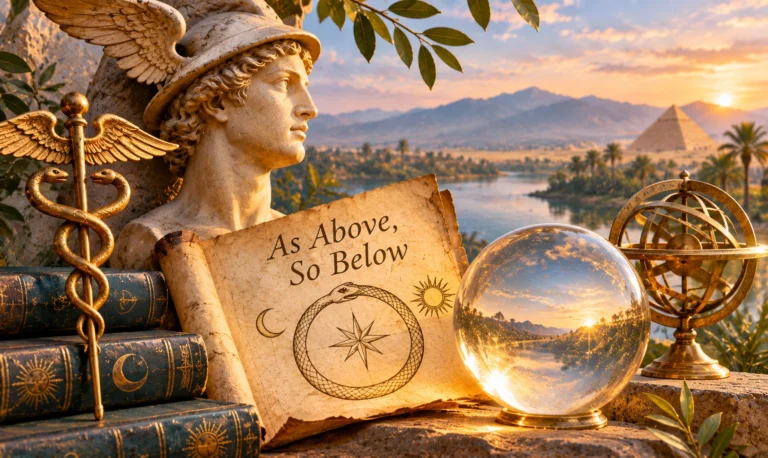
- The serpent: danger and temptation, but also healing and renewal, since it sheds its skin. It still winds around the staff of medicine.
- Light and darkness: knowing and not knowing, the conscious and the hidden.
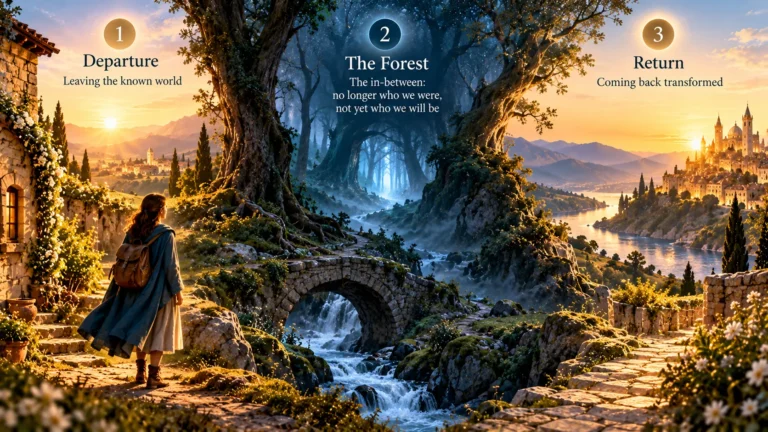
- The threshold: every passage from one state of life to another.
In the Masonic tradition, the square stands for acting fairly and the compasses for keeping one’s desires within bounds. As the Museum of Freemasonry in London explains, together they sum up the aim of a moderate and upright life. The same logic applies everywhere: an ordinary object becomes a mirror of the inner life.
What do symbols teach about our own lives?
In the great traditions, symbols are not decorations: they are tools for living. They give a shape to experiences that are hard to put into words, especially at turning points.
Take a man who leaves his country to start again abroad. On the day he leaves, he keeps the key of his old home, even though the door no longer exists for him. Months later, he notices that this key has become a symbol: a threshold crossed, a past he honors without returning to it. When he finally hangs it on the wall of his new apartment, he feels that something has settled. The image allowed him to name an existential passage that ordinary language could not quite reach.
Freemasonry offers a similar teaching with its rough stone, the person as they are, which each member works to shape. The stone is not condemned; it is raw material. Symbols remind us that we are works in progress, and that change happens one stone at a time.
What is the deeper meaning of a symbol?
At a deeper level, the traditions agree that a symbol connects the visible and the invisible. The Hermetic maxim “as above, so below” expresses this idea: what we see can point to what we cannot see. Like the great myths, a symbol is not only understood; it is lived from the inside.
Here the symbol returns to its origin. Like the broken token, it carries only half of the meaning; the other half is the person who receives it. A symbol that is only explained remains an object; a symbol that is lived becomes a path. This is why gnosis, Kabbalah and Freemasonry teach through symbols rather than dogmas. Freemasonry’s unfinished temple says it in its own way: the building to be raised is the human being. Kabbalistic psychology applies the same idea to the inner life.
What does modern research say about symbols?
The philosopher Ernst Cassirer (1944) described the human being as a “symbolic animal”: we live less among things than among meanings. This is a philosophical thesis, not an experimental result.
In cognitive science, George Lakoff and Mark Johnson argued in Metaphors We Live By (1980) that ordinary thought relies on images drawn from the body. We speak of an “upright” person or a “balanced” life without noticing it.
Research on rituals by Alison Wood Brooks and colleagues (2016) has found that performing a short sequence of symbolic actions before a stressful task reduced anxiety and improved performance. These findings echo the traditional intuition that symbols act on us; they do not prove any doctrine. How symbols arise in consciousness remains an open question.
In a nutshell
Symbolism is the language of images that religions, myths and esoteric traditions use to pass on what words alone cannot. Born from a broken token that two people fitted together, a symbol finds its meaning in the one who receives it. A circle, a tree, a key or a builder’s square can become a lesson in how to live.
Practice: Your Personal Symbol (10 minutes)
Choose an object or an image that has drawn your attention lately, then write for two minutes on each question:
- What do I see? Describe it simply: shape, color, material.
- What does it suggest? Which ideas, memories or feelings does it evoke?
- What does it teach me? What does it say about the situation I am living now?
- What does it ask of me? Is there one small step it invites me to take?
Then ask yourself: why did this image come to me now? This is a reflective exercise, not therapy.
Quote
“The symbol gives rise to thought.” — Paul Ricoeur, The Symbolism of Evil
Sources
- Cassirer, Ernst. An Essay on Man. Yale University Press, 1944.
- Ricoeur, Paul. The Symbolism of Evil. Translated by Emerson Buchanan. Beacon Press, 1967.
- Önnerfors, Andreas. Freemasonry: A Very Short Introduction. Oxford University Press, 2017.
- Lakoff, George, and Mark Johnson. Metaphors We Live By. University of Chicago Press, 1980.
- Brooks, Alison Wood, et al. “Don’t Stop Believing: Rituals Improve Performance by Decreasing Anxiety.” Organizational Behavior and Human Decision Processes 137 (2016).
Go deeper
- The Awakening Journal — a free reflective workbook to deepen your spiritual intelligence.
Related articles
- What Are Myths and Tales For? (Wisdom & Spirituality)
- What Is Alchemy? (Wisdom & Spirituality)
- What Is Kabbalistic Psychology? (Consciousness & Psychology)
By Elizabeth Carrio, MSc in Consciousness and Transpersonal Psychology · Published October 18, 2026 · Last updated October 18, 2026 · Disclaimer