
What Is Consciousness?
Consciousness is the one thing we know from the inside, and the hardest thing to study from the outside. What do we really mean by consciousness? Can we trust what we feel? And how can science and inner experience help each other understand it?
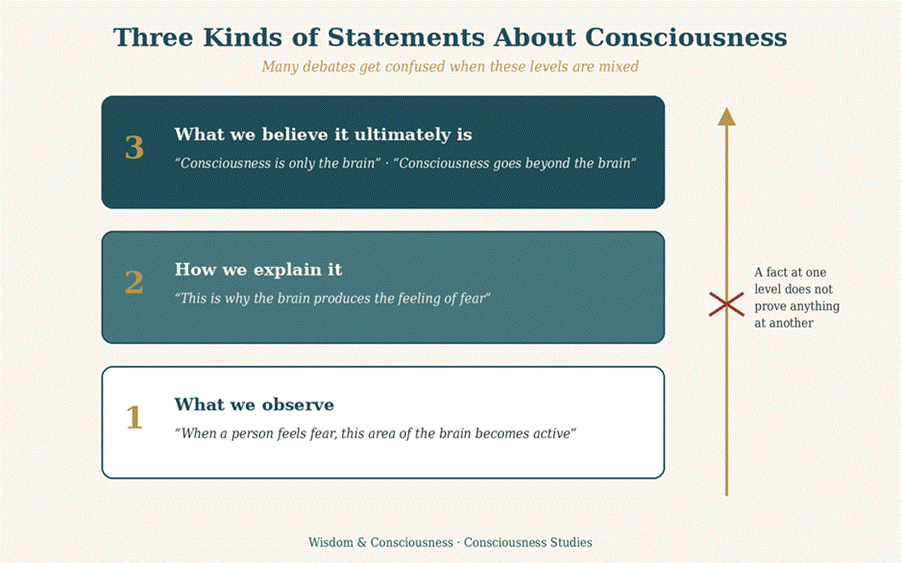
Three kinds of statements about consciousness: a fact at one level does not prove anything at another.
Consciousness studies is one of the fields of the Psychology door, at the crossroads of philosophy, psychology and neuroscience. I recently attended a conference on consciousness. All day long, the same debates came back: is consciousness made by the brain, or is it something more? Science or spirit? Each speaker defended their side with passion.
But I left with a different question in mind. Before asking what consciousness is, shouldn’t we ask how we can know anything about it at all? This question concerns anyone who wants to know themselves: everything we live, we live through consciousness.
This is the question I would like to explore here: where it comes from, what we mean by consciousness, whether we can trust what we feel, and what research tells us today.
Where does the question of consciousness come from?
Long before laboratories, contemplative and shamanic traditions explored consciousness from the inside, through meditation, prayer, ritual and the training of attention. The Gnostics even saw direct inner knowledge as the way to truth. Modern psychology began with the same ambition: in 1890, William James described consciousness as a “stream” of thought, always moving, never cut into pieces.
In the twentieth century, philosophers sharpened the question. Thomas Nagel (1974) asked what it is like to be a bat, to show that every conscious being has a point of view that outside facts cannot capture. Then David Chalmers (1995) gave the puzzle its famous name, the “hard problem”: even if we knew everything about the brain, we would still wonder why all this activity feels like something.
What do we mean by consciousness?
Think of a simple moment: you taste a strawberry. Only you know exactly what that taste is like for you. I can see your smile, hear your words, even measure your brain activity. But I can never taste it from the inside, as you do.
This is what makes consciousness unlike anything else we study. A stone, a planet or a cell can be observed from the outside. Consciousness is lived from the inside. Researchers speak of the first-person view (what I live) and the third-person view (what others can observe). Studying consciousness means learning to bring the two together.
Can we trust what we feel?
If consciousness is lived from the inside, the best witness seems to be the person who lives it. When someone says “I felt a presence” or “I felt deep peace”, that is precious information, as the study of religious experience shows.
But our inner reports are not perfect. Our memory, our words, our beliefs and our expectations all colour what we describe. Research on introspection (Schwitzgebel, 2008) suggests that we can be wrong about our own experience, even when we feel completely sure.
Does this mean we should ignore personal experience? Not at all. It means we need to listen to it carefully: asking good questions, without leading the person, and comparing what they say with other clues, such as behaviour or what happens in the body. This matters to me personally. In my own research in transpersonal psychology, I used a method that treats the researcher’s inner experience as a real source of knowledge. I know how rich this can be, and also how easily we can fool ourselves.
How can science and spirituality speak about it?
Many arguments get confused because people mix up three different kinds of statements:
- What we observe: “When a person feels fear, this area of the brain becomes active.”
- How we explain it: “This is why the brain produces the feeling of fear.”
- What we believe consciousness ultimately is: “Consciousness is only the brain”, or “Consciousness goes beyond the brain.”
A fact at the first level does not prove anything at the third, and this works both ways. Science has not yet explained why we feel what we feel; that gap does not prove that consciousness is spiritual either. Two traps follow: thinking that only what can be measured is real, and thinking that a strong experience proves its own meaning. The path I believe in lies between the two: taking inner experience seriously, while remaining humble about how we interpret it.
What does modern research say about it?
Today there are many competing scientific theories of consciousness, and researchers do not agree on which one is right. Recently, a large international project tried something new. Supporters of two rival theories agreed in advance on what each one predicted, then neutral teams ran the experiments. Published in 2025 (Cogitate Consortium), the results partly supported each theory and seriously challenged key claims of both. I find this beautiful: the disagreement did not disappear, but it became more honest and more useful.
Other researchers try to join the two views. Francisco Varela (1996) proposed training people to describe their experience precisely and studying these descriptions alongside brain data. This remains an approach under development, not a settled result. So, at the next conference, I would like to ask: “How can we bring together inner experience and outside observation, so that each one helps us understand the other?”
✦
In a nutshell
Consciousness is what we live from the inside: the felt quality of every moment. Consciousness studies, a field at the crossroads of philosophy, psychology and neuroscience, seeks to know it by bringing together careful inner experience and outside observation, without confusing facts, explanations and beliefs.
Practice: The Gap Between Experience and Words (5 minutes)
Sit comfortably, with a notebook within reach.
- Close your eyes for one minute and notice what you are experiencing: sounds, sensations, thoughts.
- Open your eyes and describe it in a few words.
- Close your eyes again for one minute, then add what your first description left out.
- Notice what was lost between the experience and your words.
Then ask yourself: what does this small gap teach me about knowing myself? That gap is the whole challenge of studying consciousness.
This is a reflective exercise, not therapy.
Quote
“Consciousness, then, does not appear to itself chopped up in bits.” — William James, The Principles of Psychology (1890)
Sources
- William James, The Principles of Psychology, Henry Holt, 1890.
- Thomas Nagel, “What Is It Like to Be a Bat?”, The Philosophical Review, 83(4), 1974.
- David J. Chalmers, “Facing Up to the Problem of Consciousness”, Journal of Consciousness Studies, 2(3), 1995.
- Francisco J. Varela, “Neurophenomenology: A Methodological Remedy for the Hard Problem”, Journal of Consciousness Studies, 3(4), 1996.
- Cogitate Consortium, “Adversarial Testing of Global Neuronal Workspace and Integrated Information Theories of Consciousness”, Nature, 642, 2025.
Go deeper
- The Awakening Journal — a free reflective workbook to deepen your spiritual intelligence.
Related articles
- Existential Psychology: Meeting the Great Questions of Life (Consciousness & Psychology)
- What Is Kabbalistic Psychology? (Consciousness & Psychology)
- What Is Tarot? (Wisdom & Spirituality)
By Elizabeth Carrio, MSc in Consciousness and Transpersonal Psychology · Published October 9, 2026 · Last updated October 17, 2026 · Disclaimer