What Is Alchemy?
Alchemy is far more than the old dream of turning lead into gold: for centuries, it was also a symbolic language for describing how a human being changes. Where does alchemy come from? What do its famous stages mean? And what can it tell us about the difficult passages of our own lives?
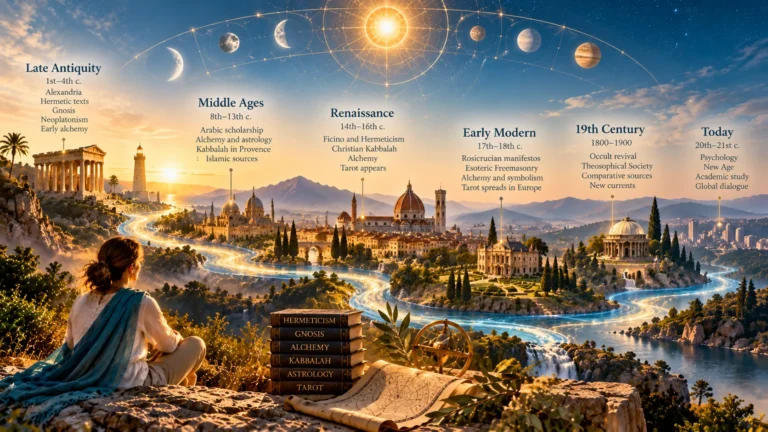
Alchemy belongs to the great esoteric traditions of the West, alongside Hermeticism, Kabbalah and Gnosis, although parallel traditions developed in China and India. It combined the study of matter with philosophy and, for many of its practitioners, with a spiritual search. Its best-known goal was the Philosopher’s Stone, a legendary substance said to turn ordinary metals into gold.
Today, alchemy interests us less for its recipes than for its images. Its stages of darkening, purification and union offer a vocabulary for something everyone eventually faces: a time when old certainties dissolve and something new has not yet taken shape. In this sense, alchemy speaks to both halves of our motto: know yourself, understand the world.
Let us look at alchemy from five angles.
Where does alchemy come from?
Western alchemy took shape in Greek-speaking Egypt, around Alexandria, in the first centuries of our era. One of its earliest known authors, Zosimos of Panopolis (around 300 CE), already described laboratory operations alongside dreams and visions. The tradition then passed into the Arabic-speaking world, where texts attributed to Jabir ibn Hayyan developed it further. Our word comes from the Arabic al-kimiya. Latin translations brought it to Europe in the twelfth century.
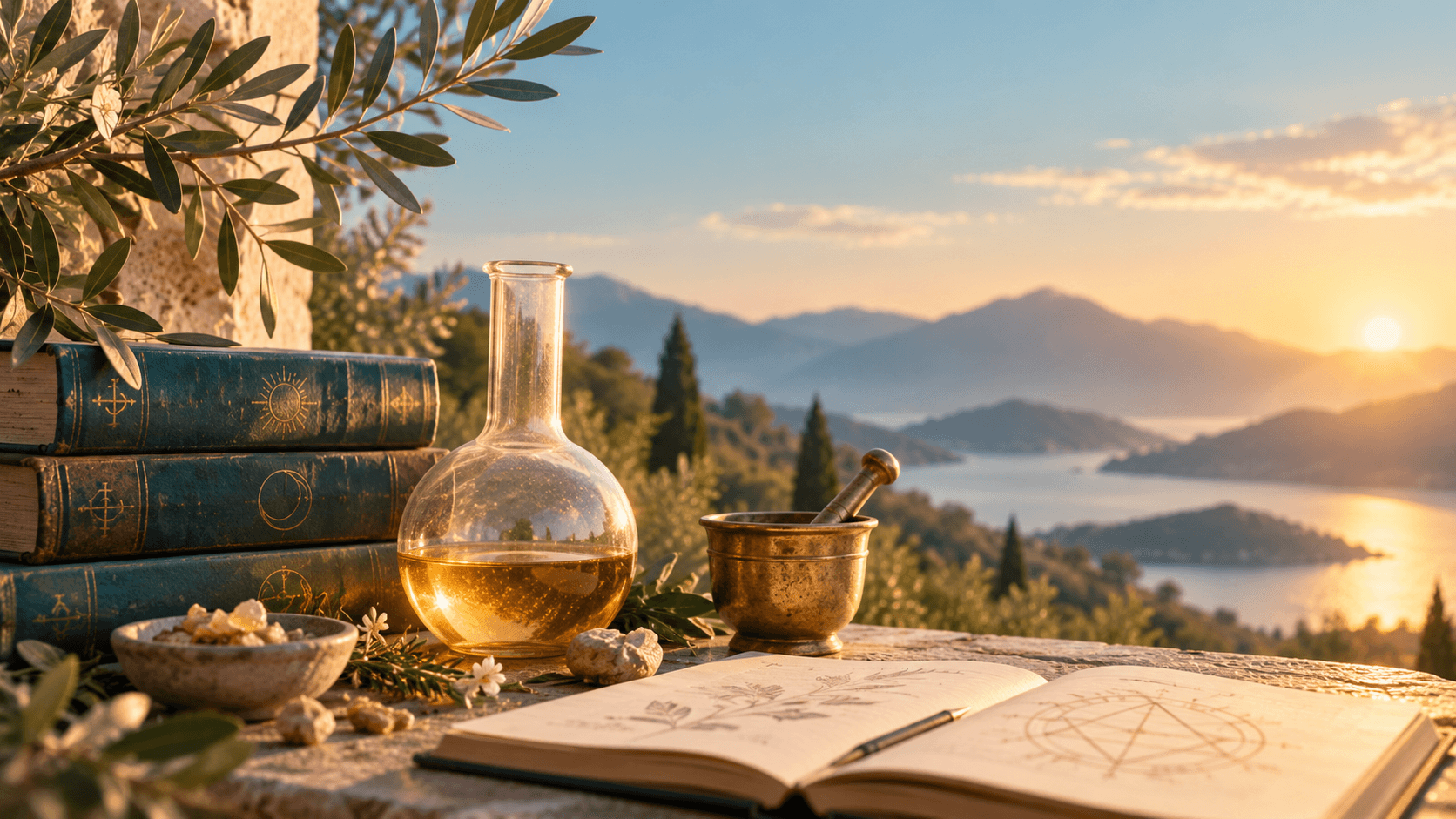
Alchemists heated, dissolved, distilled and purified metals, minerals and plants. Some sought gold; others, like Paracelsus (1493–1541), sought medicines. Even Isaac Newton wrote over a million words on the subject. Historians such as Lawrence Principe point out that, for most of its history, alchemy was a practical laboratory art. The purely spiritual reading became widespread mainly in the nineteenth and twentieth centuries.
What do the stages of alchemy symbolize?
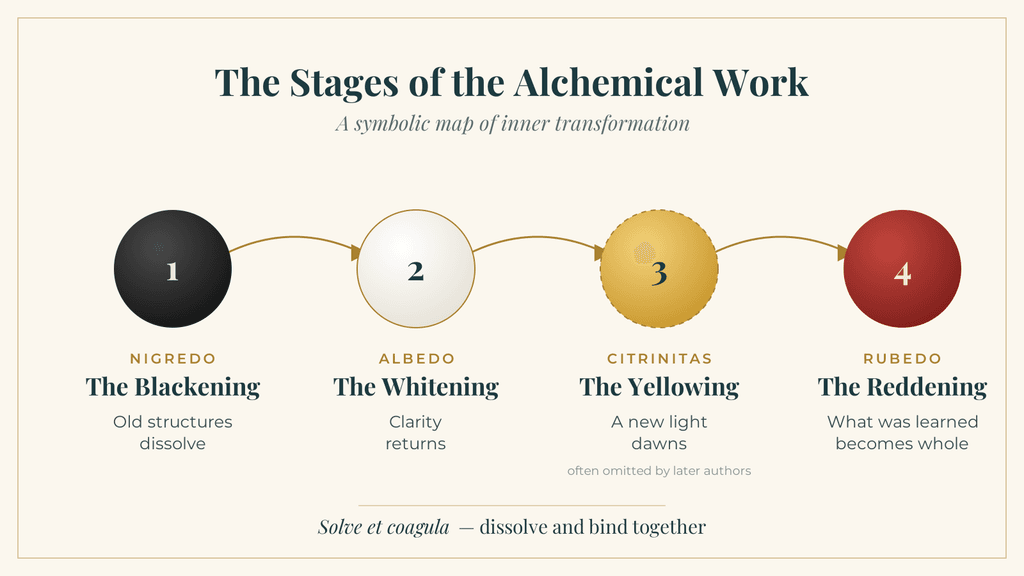
Symbolically, the alchemical work is a story told in colors. Older texts describe four stages; later authors usually kept three:
- The blackening (nigredo): matter breaks down and decays. Symbolically, old structures dissolve.
- The whitening (albedo): matter is washed and purified. Symbolically, clarity returns.
- The reddening (rubedo): opposites are joined and the Stone appears. Symbolically, what has been understood becomes whole.
The four elements add a second language: earth for stability, water for emotion, air for thought, fire for energy and change. A famous maxim sums up the method: solve et coagula, “dissolve and bind together.” In alchemical symbolism, nothing new can be formed until something old has been taken apart.
What does alchemy teach about difficult times?
In the alchemical tradition, the blackening is not a failure of the work but its necessary beginning. This may be alchemy’s most useful lesson for anyone going through a major change.
Take someone who loses a job after twenty years. At first come shame, anger or fear: a familiar identity dissolves. Instead of pushing these feelings away, they take time to see what the experience reveals about their expectations, values and needs. Slowly, clarity returns. They may change direction, learn a new skill or define success differently.
The event has not disappeared; what has changed is their relationship to it. Alchemy also reminds us that transformation needs time and the right conditions: steady heat, a sealed vessel, patience. And it rarely follows a straight line. Alchemists repeated their operations many times, just as we return to the same questions, each time at a deeper level.
What is the “inner gold”?
At its deepest level, the tradition suggests that the alchemist is also the material being transformed. The Emerald Tablet, a short Hermetic text that inspired many alchemists, teaches that what is above mirrors what is below. Read in this light, the outer laboratory becomes an image of inner life: experiences are the raw material, attention is the fire, and reflection is the vessel that holds the process.
The gold is then neither wealth nor perfection, but a self that has become more conscious and more whole, in which opposing parts can work together. Kabbalistic and Christian mystical currents describe similar journeys of purification and union, each in its own language.
What does modern research say about alchemy?
Historically, alchemy did feed into science: its laboratory techniques contributed to the birth of modern chemistry. In 2025, physicists at CERN even reported fleeting traces of gold produced from lead in particle collisions — through nuclear physics, not alchemy.
On the inner side, Carl Jung (1944) read alchemical images as symbols of psychological integration, a reading later taken up by transpersonal psychology. This is a scholarly interpretation, not an experimental result. Separately, research on post-traumatic growth (Tedeschi and Calhoun, 2004) has found that many people report positive changes after a major life crisis, such as new priorities or deeper relationships. These findings echo the alchemical intuition that darkness can open a path; they do not prove it.
In a nutshell
Alchemy is an ancient tradition, born in Hellenistic Egypt, that sought to transform matter and, for many of its followers, the soul. Its stages of blackening, whitening and reddening offer a symbolic map of inner change: what dissolves in a crisis can, with time and attention, be clarified and integrated into a more conscious life.
Practice: The Three Questions (10 minutes)
Think of a difficulty you are facing now. Take a sheet of paper and write for three minutes on each question:
- Blackening. What needs to be recognized? Which feelings, fears or assumptions am I avoiding?
- Whitening. What is becoming clearer? What have I learned about myself or my situation?
- Reddening. What can I integrate? What is one concrete change I could make this week?
Read what you wrote without judging it, and ask yourself: what in my life is asking to be understood, transformed or brought into greater harmony? This is a reflective exercise, not therapy.
Quote
“That which is below is like that which is above, and that which is above is like that which is below.” — The Emerald Tablet, translated by Isaac Newton
Sources
- Faivre, Antoine. Western Esotericism: A Concise History. State University of New York Press, 2010.
- Principe, Lawrence M. The Secrets of Alchemy. University of Chicago Press, 2012.
- Principe, Lawrence M., and William R. Newman. “Some Problems with the Historiography of Alchemy.” In Secrets of Nature, MIT Press, 2001.
- Jung, Carl Gustav. Psychology and Alchemy. Collected Works, vol. 12. 1944; Princeton University Press, 2nd ed., 1968.
- Tedeschi, Richard G., and Lawrence G. Calhoun. “Posttraumatic Growth: Conceptual Foundations and Empirical Evidence.” Psychological Inquiry 15, no. 1 (2004).
Go deeper
- The Awakening Journal — a free reflective workbook to deepen your spiritual intelligence.
Related articles
- Tarot: A Mirror for Knowing Yourself (Wisdom & Spirituality)
- What Is Kabbalistic Psychology? (Consciousness & Psychology)
- Existential Psychology: Meeting the Great Questions of Life (Consciousness & Psychology)
By Elizabeth Carrio, MSc in Consciousness and Transpersonal Psychology · Published October 17, 2026 · Last updated October 17, 2026 · Disclaimer