What Is Transpersonal Psychology?
Transpersonal psychology is the branch of psychology that studies experiences in which a person feels connected to something larger than their individual self. Where does it come from? What does it say about life crises and awakenings? And how seriously does science take it today?
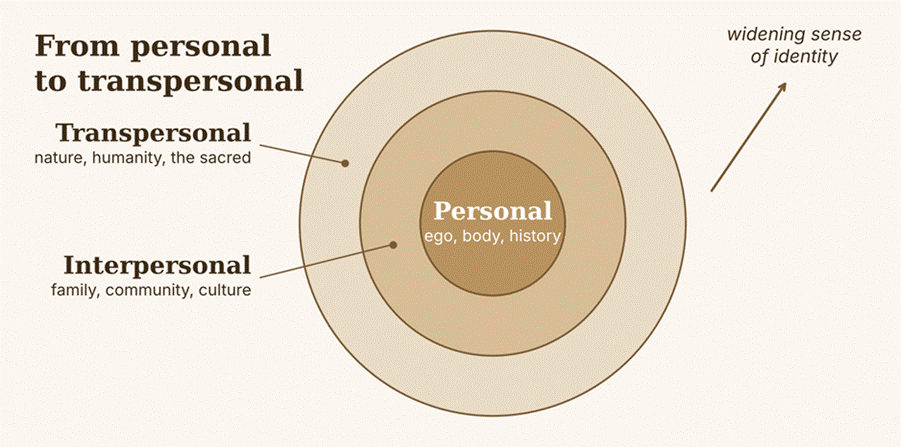
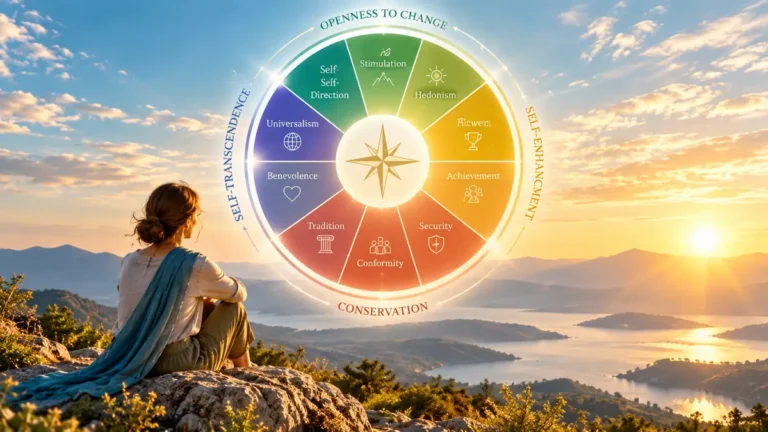
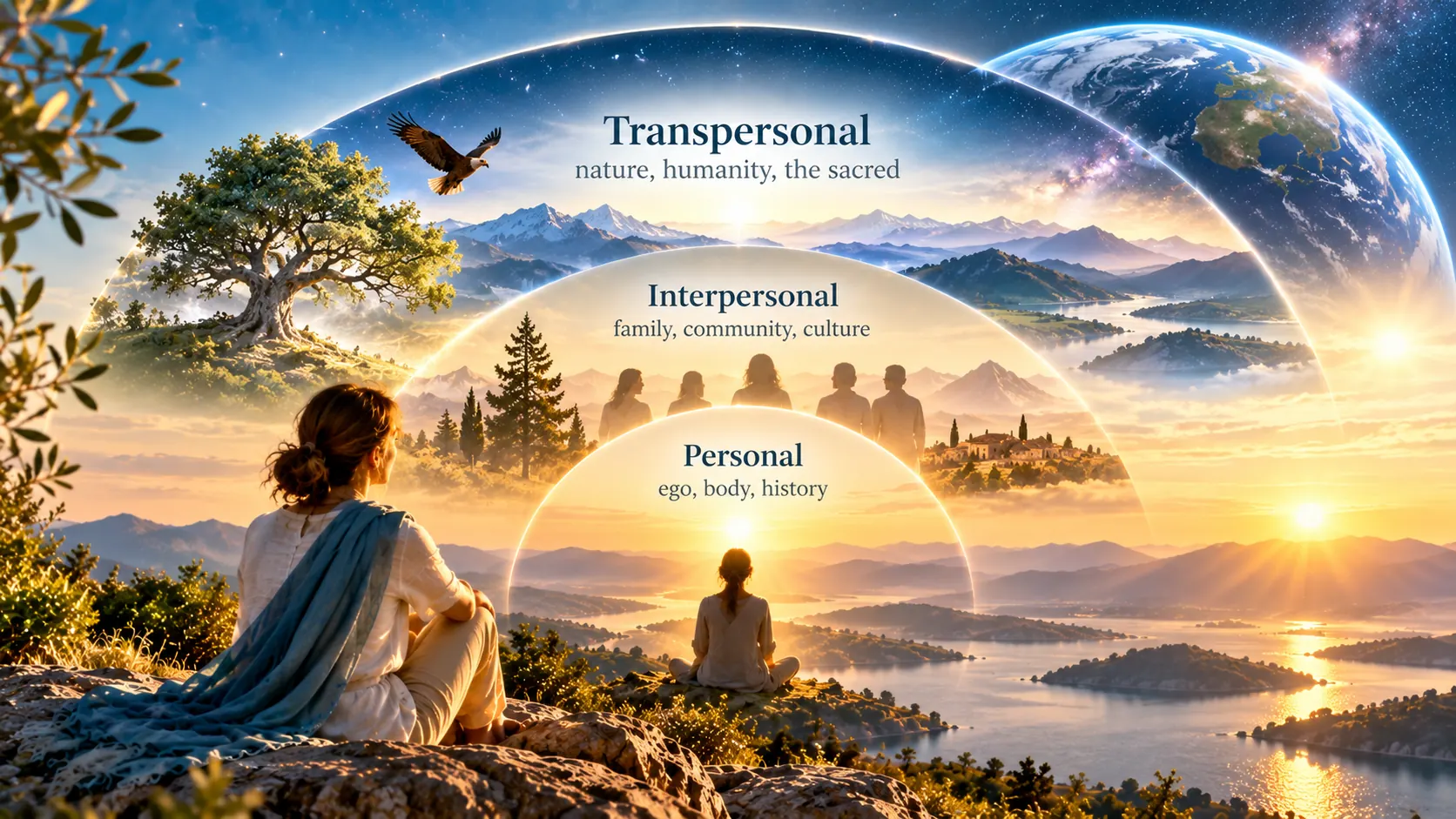
Symbolically, transpersonal psychology widens the circle of identity beyond the personal self.
Transpersonal psychology is a field of modern psychology that draws on the great wisdom traditions without belonging to any of them. The word “transpersonal” means “beyond the personal”: it points to experiences in which our sense of identity reaches past the individual ego to include others, nature, humanity or the sacred.
Such experiences are not rare. A moment of awe before the ocean, a deep sense of unity in meditation, the feeling after a loss that life holds a meaning we had never seen: many people know these moments but have no framework to understand them. Mainstream psychology has long set them aside, or read them only as symptoms.
Transpersonal psychology takes them seriously, without dogma and without religious affiliation. It asks what they reveal about human consciousness, how they can transform a life, and when they turn into a crisis that needs support. In doing so, it extends the questions of existential psychology — meaning, freedom, finitude — toward what the spiritual traditions have long explored.
Where does transpersonal psychology come from?
Transpersonal psychology grew out of humanistic psychology in the United States in the late 1960s. Abraham Maslow, who had studied “peak experiences” — moments of intense joy, clarity or unity — came to believe that self-actualization was not the summit of human development. In his late work he described a further level, self-transcendence, and he called the emerging field the “fourth force” in psychology, after behaviorism, psychoanalysis and humanistic psychology.
In 1969, Maslow and Anthony Sutich launched the Journal of Transpersonal Psychology; the Association for Transpersonal Psychology followed in 1972. The psychiatrist Stanislav Grof brought decades of clinical research on non-ordinary states of consciousness. Earlier thinkers are counted as forerunners: William James, whose The Varieties of Religious Experience (1902) treated spiritual experience as a subject of study, Carl Jung, and Roberto Assagioli, whose psychosynthesis described a “higher self”.
What are the key ideas of transpersonal psychology?
In 1992, Denise Lajoie and S. I. Shapiro reviewed some forty definitions published over the field’s first twenty-three years. What they shared was a concern with humanity’s highest potential and with unitive, spiritual and transcendent states of consciousness. Three notions follow from this.
The first is the transpersonal experience itself: a moment when the boundary between “me” and the world loosens. The second treats non-ordinary states — in meditation, prayer, deep absorption in music or nature — as possible sources of knowledge, not only as anomalies. The third is the transpersonal self: a level of identity broader than the ego, in which the ego does not disappear but finds its place.
Picture a grandmother holding her first grandchild who suddenly feels part of a long chain of generations. Nothing supernatural has happened, yet her sense of who she is has widened. That widening is what the word “transpersonal” describes.
What does transpersonal psychology reveal about life crises?
One of the field’s most useful ideas concerns crises. In 1989, Stanislav and Christina Grof introduced the term spiritual emergency — a play on “emergence” and “emergency” — for periods when inner transformation becomes overwhelming: familiar bearings collapse, intense experiences arise, and the person may fear they are losing their mind.
In the transpersonal view, such a crisis may also be a passage. Consider a woman of sixty who retires and moves abroad. For months she feels she has lost her identity; old roles no longer fit, and questions she had set aside — what was my life for? what remains to be done? — return with force. A reading focused only on symptoms sees a problem to fix. A transpersonal reading also asks what is trying to emerge.
This does not mean romanticizing distress. The Grofs themselves stressed that some crises call for medical care, and that telling the two apart is essential.
How does transpersonal psychology relate to the wisdom traditions?
From the start, transpersonal psychology has turned to the traditions for maps of inner experience. The stages of meditation in Buddhism, the Sufi path, the alchemical work, the Tree of Life of the Kabbalah or the shaman’s journey each describe, in their own language, what happens when consciousness widens. Kabbalistic psychology and shamanic psychology are two of the bridges built between these traditions and modern practice.
Early authors often assumed that all traditions point to the same summit, an idea known as the “perennial philosophy”. Later scholars, notably Jorge Ferrer (2002), questioned this: each tradition may open onto a different reality rather than offer a different view of a single one. This is a scholarly interpretation, not an experimental result, but it matters. It invites us to learn from each tradition on its own terms rather than blend them.
What does modern research say about transpersonal psychology?
The field has gained some recognition. Since the DSM-IV (1994), the main American diagnostic manual has included a heading, “Religious or Spiritual Problem”, proposed by David Lukoff, Francis Lu and Robert Turner, so that spiritual distress is not automatically treated as mental illness. A review by David Yaden and colleagues (2017) found that self-transcendent experiences are widespread and are often associated with well-being and a stronger sense of connection to others. Neuroscience has begun to map the brain activity linked to such states, but a correlation is not an explanation.
The limits are real. Many transpersonal notions are hard to measure, and the field remains marginal in academic psychology. Research shows that these experiences exist and matter to people; it does not prove any doctrine about what lies beyond them.
✦
In a nutshell
Transpersonal psychology studies the experiences in which our sense of identity reaches beyond the personal self — toward others, nature or the sacred. Drawing on the wisdom traditions without belonging to any of them, it helps us understand awakenings and crises as possible passages of growth.
Practice: The Widening Circle (10 minutes)
Sit comfortably with a notebook and take a few slow breaths.
- Recall a moment when you felt part of something larger than yourself: in nature, with music, with a loved one, in silence.
- Write down what you saw, felt and understood, without judging or interpreting it.
- Note how your sense of “I” changed in that moment. Did it soften, expand, become quieter?
- Bring to mind a change you are going through now, and look at it for a minute from that wider place.
What do you see from there that you could not see before?
This is a reflective exercise, not therapy.
Quote
“We need something ‘bigger than we are’ to be awed by and to commit ourselves to.” — Abraham Maslow, Toward a Psychology of Being, 1968
Sources
- Ferrer, J. N., Revisioning Transpersonal Theory: A Participatory Vision of Human Spirituality, SUNY Press, 2002.
- Friedman, H. L. and Hartelius, G. (eds.), The Wiley-Blackwell Handbook of Transpersonal Psychology, Wiley-Blackwell, 2013.
- Grof, S. and Grof, C. (eds.), Spiritual Emergency: When Personal Transformation Becomes a Crisis, Tarcher, 1989.
- Maslow, A. H., Toward a Psychology of Being, 2nd ed., Van Nostrand, 1968.
- Yaden, D. B. et al., “The Varieties of Self-Transcendent Experience“, Review of General Psychology, 21(2), 2017.
Go deeper
The Awakening Journal — a free reflective workbook to deepen your spiritual intelligence.
Related articles
- What Is Consciousness? (Consciousness & Psychology)
- Existential Psychology: Meeting the Great Questions of Life (Consciousness & Psychology)
- What Is Alchemy? (Wisdom & Spirituality)
By Elizabeth Carrio, MSc in Consciousness and Transpersonal Psychology · Published October 18,2026 · Last updated October 2026 · Disclaimer