What Is Gnosis?
Gnosis is a knowledge that does not come from books but from inner recognition: knowing who you really are. Where does this ancient idea come from? Why did it trouble the early Church? And what can it still teach us about knowing ourselves today?
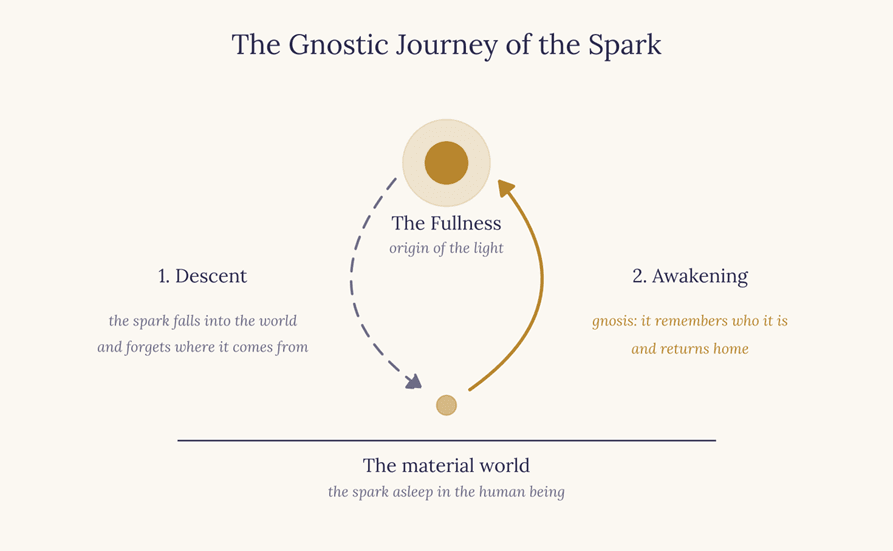
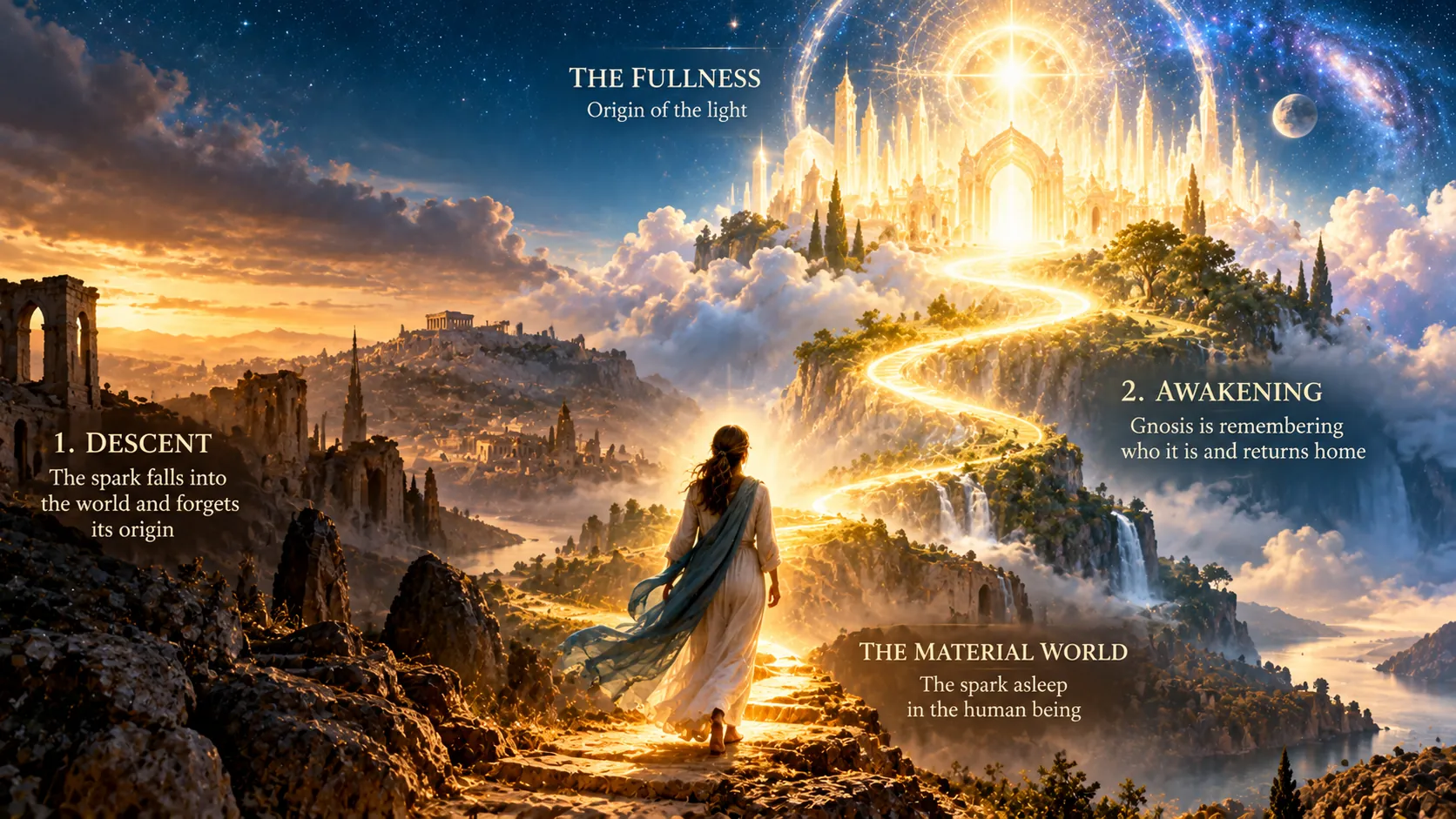
Symbolically, gnosis describes a spark of light that descends into the world, forgets its origin, and awakens to return home.
Gnosis belongs to the great esoteric traditions of the West, alongside Hermeticism, alchemy and Kabbalah. The word comes from the Greek gnōsis, “knowledge,” but not the knowledge of facts. It means the kind of knowing we have of a person we have met: direct, lived, and transforming.
For the Gnostic teachers of the first centuries, this knowledge was the key to freedom. In their eyes, human beings suffer less from sin than from forgetting: they have lost the memory of where they come from. To know oneself is to remember.
This intuition runs through the whole history of Western spirituality, and it meets a very modern question: who are we, beyond our roles? Let us look at gnosis from five angles.
Where does gnosis come from?
Gnosis took shape in the first and second centuries of our era, in the eastern Mediterranean, and especially in Alexandria, where Greek philosophy, Jewish scripture, Egyptian religion and early Christianity met. Teachers such as Basilides and Valentinus founded schools there and in Rome. For centuries, we knew them mainly through their opponents: around 180, Irenaeus of Lyon wrote Against Heresies to refute them.
Everything changed in December 1945. Near Nag Hammadi, in Upper Egypt, a farmer named Muhammad Ali al-Samman dug up a sealed jar containing thirteen leather-bound books. They held about fifty texts in Coptic, among them the Gospel of Thomas, the Gospel of Truth and the Gospel of Philip. They also included Hermetic writings, a sign that the two traditions circulated in the same circles.
Historians today are cautious. Karen King (2003) has shown that “Gnosticism” is a modern label grouping very different movements. It is more accurate to speak of gnosis as a shared aspiration than of a single religion.
What do the Gnostic myths symbolize?
The Gnostic texts tell a great drama of descent and return. In the Valentinian version, everything begins in the Pleroma, the “Fullness” of the divine. Sophia, Wisdom, the youngest of the divine powers, longs to know the unknowable source on her own. From her longing arises a lesser maker, the Demiurge, who shapes the material world without knowing what lies above him. Sparks of divine light remain hidden in human beings, asleep.
Symbolically, this is not a story about the distant past but a map of consciousness: a part of us comes from elsewhere, has forgotten, and can wake up.
The most beautiful example is the Hymn of the Pearl, one of the great myths of late antiquity, preserved in the Acts of Thomas. A young prince is sent to Egypt to bring back a pearl guarded by a serpent. He eats the local food, forgets his mission and falls asleep. A letter from his parents reaches him, flying like an eagle, and as he reads it he remembers who he is. He wins the pearl and returns home, where a royal robe awaits him, a robe in which he sees his own image.
What does gnosis teach about knowing yourself?
In the Gnostic tradition, the human problem is first of all ignorance: we live asleep, identified with what we are not. A Valentinian teacher named Theodotus, quoted by Clement of Alexandria, summed up the questions that set us free: who we were and what we have become, where we were and where we have been thrown, where we are hastening and from what we are redeemed, what birth is and what rebirth is.
Consider a woman who retires after thirty years in an international organization. For months she feels lost: without her title, her schedule and her network, who is she? This existential question frightens her, yet it is also an opening. A Gnostic reading would say: you are not your roles; you have simply forgotten what was there before them.
The tradition implies a simple principle: wisdom is universal, but knowledge is personal. No one can wake up in our place.
What is the deeper meaning of gnosis?
At its deepest, gnosis is a knowledge in which the knower and the known are no longer separate. The Gospel of Philip puts it this way: “You saw the Spirit, you became spirit.” The Hermetic writings say the same in other words: only like can know like. This is why gnosis cannot be passed on like information. It is recognized, as one recognizes a face.
This reading also calls for discernment. Some Gnostic texts treat the body and the world as a prison. The philosopher Plotinus already criticized the Gnostics for this contempt of the cosmos. A contemporary reading need not follow them: awakening does not mean escaping life, but inhabiting it more consciously. Read this way, gnosis is close to what is called today spiritual intelligence.
What does modern research say about gnosis?
Gnosis cannot be tested in a laboratory, but several fields echo its central intuition. The psychologist William James (1902) observed that mystical states have a “noetic quality”: those who live them describe them as states of knowledge, not only of feeling. Ralph Hood (1975) later built a questionnaire that measures this dimension, and it is still widely used in the psychology of religion.
Research on self-transcendent experiences (Yaden and colleagues, 2017) reports that such moments are common and often associated with a greater sense of meaning and connection. These findings do not prove the Gnostic myth; they echo its idea that knowing oneself can be lived as an awakening.
Carl Jung took a close interest in the Gnostics: one of the Nag Hammadi books, acquired in 1952 by the Jung Institute in Zurich, became known as the Jung Codex. He read their myths as images of a psyche seeking wholeness, a line explored today in transpersonal psychology. This is a scholarly interpretation, not an experimental result.
In a nutshell
Gnosis, one of the great esoteric traditions of the West, is a liberating knowledge of oneself. It is not information but recognition: the memory of who we are beyond our roles. Its myths describe a spark of light that forgets its origin, then awakens and returns home.
Practice: The Five Questions of Theodotus (10 minutes)
Sit with a notebook and answer each question in two or three lines, without censoring yourself.
- Who was I before my current roles?
- What have I become?
- Where have I been “thrown”: which situations did I not choose?
- Where am I hastening, and is it truly my direction?
- What in me is asking to be reborn?
Reread your answers and underline one sentence that surprises you. What does it tell you that you had forgotten?
This is a reflective exercise, not therapy.
Quote
“When you become acquainted with yourselves, then you will be recognized. And you will understand that it is you who are children of the living father.” — Gospel of Thomas, saying 3, translated by Bentley Layton
Sources
- Hans Jonas, The Gnostic Religion, Beacon Press, 1958 (3rd ed. 2001).
- Elaine Pagels, The Gnostic Gospels, Vintage, 1979.
- Karen L. King, What Is Gnosticism?, Belknap Press of Harvard University Press, 2003.
- Gary Lachman, The Secret Teachers of the Western World, TarcherPerigee, 2015.
- David B. Yaden et al., “The Varieties of Self-Transcendent Experience,” Review of General Psychology, 2017.
Go deeper
The Awakening Journal — a free reflective workbook to deepen your spiritual intelligence.
Related articles
- What Is Alchemy? (Wisdom & Spirituality)
- What Is Spiritual Intelligence? (Consciousness & Psychology)
- What Is Transpersonal Psychology? (Consciousness & Psychology)