
What Is Kabbalistic Psychology?
Kabbalistic psychology reads the Tree of Life, the central map of Jewish mysticism, as a description of the human psyche. Where does this approach come from? What do the ten sefirot say about the way we think, feel and act? And how can this ancient map help us make better choices today?
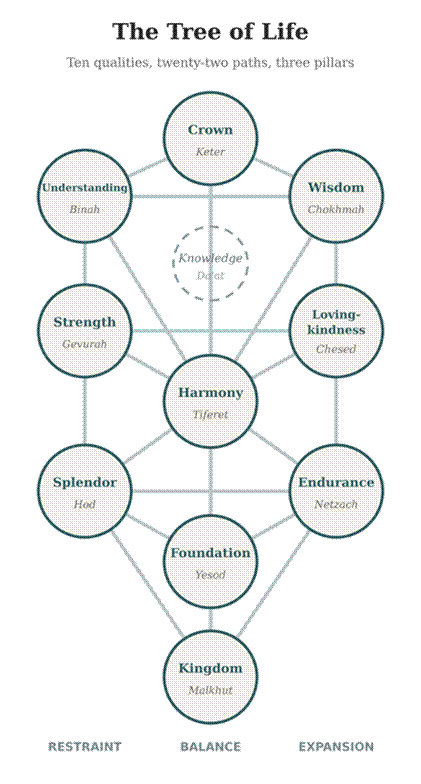
Symbolically, the Tree of Life maps ten qualities of the psyche, from inspiration at the top to action at the bottom.
Kabbalistic psychology is one of the applications of the Kabbalah, the mystical tradition of Judaism. It reads the Tree of Life, the Kabbalah’s central diagram, as a map of the inner world: ten qualities and the paths that connect them.
To know yourself, it offers a precise vocabulary for the forces at work in us: expansion and restraint, intuition and reason, desire and action. To understand the world, it shows the same structure at work in relationships, groups and organizations.
It requires no religious belief, only close attention to how our inner life is organized. Let us look at it from five angles.
Where does Kabbalistic psychology come from?
The Kabbalah took shape in Provence and Spain from the late twelfth century. Its central idea is that the infinite becomes knowable through ten emanations, the sefirot.
Scholars long studied this tradition as history. Gershom Scholem, the founder of the field, nevertheless wrote that “the historian’s task ends where the psychologist’s begins” (1969). The psychological reading is older than the term: in the eighteenth century, Hasidic teachers were already describing the sefirot as powers of the human soul.
The expression “Kabbalistic psychology” was developed by Sanford Drob (2003) in relation to Jung. Transpersonal psychologist Les Lancaster uses it more broadly, as a dialogue between psychology and particular forms of the Kabbalah rather than a single unified system.
What are the sefirot, and what do they mean for the psyche?
In the kabbalistic tradition, the ten sefirot are connected by twenty-two paths and arranged in three pillars: expansion on the right, restraint on the left, balance in the middle. Read in human terms, each one names a function.
The Crown stands for will and inspiration; Wisdom for intuitive insight; Understanding for reasoned thought. Loving-kindness and Strength stand for generosity and discipline, and Harmony for the balancing heart. Endurance and Splendor stand for drive and expression, the Foundation for imagination, and the Kingdom for action in the concrete world.
As a symbol, the Tree describes energy moving from the most subtle level to the most concrete, and back. Take a decision to change careers. The idea arrives as a flash (Wisdom), takes shape as a plan (Understanding), is weighed between enthusiasm and caution (Loving-kindness and Strength), and finally becomes a step taken (Kingdom).
What does the Tree of Life reveal about human life?
The first lesson is that there is a structure, and within it, we are free. The Tree does not tell us who to be; it shows the forces we work with.
The second lesson is balance. According to the tradition, generosity without limits becomes smothering, and discipline without love becomes harsh control. A parent who can never say no and a parent who can never relent suffer from the same imbalance, seen from opposite sides. Harmony, at the heart of the Tree, holds both. Many of our difficulties are not defects but imbalances.
The third lesson concerns the path from the Kingdom to the Foundation: the outside world often acts as a mirror. If a colleague’s need for attention irritates us deeply, it may point to our own unmet need for recognition. Noticing this is the first step of spiritual intelligence.
How does it connect with the wisdom traditions?
In the sixteenth century, the kabbalist Isaac Luria told of vessels that shattered because they could not contain the divine light, scattering sparks into the world. The human task is to gather them.
Read psychologically, this describes the moments when our inner structures can no longer hold what we are living: a loss, an exile, a turning point. Repair does not mean going back. It means recovering what was valuable and building a larger vessel.
The tradition places this crossing at a hidden point of the Tree, Knowledge (Da’at), at the edge of what kabbalists call the abyss. It can be a place of confusion and resentment, or of purification. It is crossed by letting go: not turning back, not holding on to what has decayed. A similar logic of dissolution and renewal runs through alchemy.
What does research say, and how can I work with it?
Drob (2003) argues that Jung’s idea of individuation echoes kabbalistic themes, largely through the alchemical texts Jung studied; in this reading, Harmony corresponds to the Self. Lancaster (2011) suggests that the Kabbalah occupies a middle ground between reducing spiritual experience to a brain state and simply asserting an Absolute: it maps how the infinite becomes accessible to consciousness.
These are scholarly interpretations, not experimental results. To date, little empirical research has tested the Tree as a psychological model. Its value lies in reflection, as in transpersonal psychology more broadly.
| In a nutshell Kabbalistic psychology is an application of the Kabbalah that reads its Tree of Life as a map of the psyche: ten complementary qualities, from inspiration to action, whose balance shapes how we think, feel and choose. It is less a doctrine than a tool for self-knowledge, at the crossroads of a mystical tradition and modern psychology. |
Practice: map your choices (10 minutes)
- List five choices you made today, from the least to the most important.
- For each one, ask what moved you: a need for control (Strength), a wish to give (Loving-kindness), getting the job done (Kingdom), satisfying your ego (Foundation), a sense of purpose (Harmony), or a moment of inspiration (Crown).
- Notice which qualities come up often, and which never do.
- Take one decision you are facing and ask: which missing quality could open a new option?
This is a reflective exercise, not therapy.
Quotes
“Ten sefirot of nothingness: ten and not nine, ten and not eleven. Understand with wisdom, be wise with understanding.” Sefer Yetzirah, 1:4
“The historian’s task ends where the psychologist’s begins.” Gershom Scholem, On the Kabbalah and Its Symbolism
Sources
Dan, J. (2006). Kabbalah: A Very Short Introduction. Oxford University Press. https://blog.oup.com/2008/01/vsi_dan/
Drob, S. L. (2003). Towards a kabbalistic psychology: C. G. Jung and the Jewish foundations of alchemy. Journal of Jungian Theory and Practice, 5(2), 77–100. https://newkabbalah.com/
Lancaster, B. L. (2005). The Essence of Kabbalah. Arcturus. https://www.goodreads.com/book/show/2181642
Lancaster, B. L. (2011). The hard problem revisited: From cognitive neuroscience to Kabbalah and back again. In H. Walach, S. Schmidt & W. B. Jonas (Eds.), Neuroscience, Consciousness and Spirituality. Springer. https://doi.org/10.1007/978-94-007-2079-4
Scholem, G. (1969). On the Kabbalah and Its Symbolism. Schocken Books. https://www.penguinrandomhouse.com/books/162202/on-the-kabbalah-and-its-symbolism-by-gershom-scholem
Go deeper
- Course: Kabbalistic Astrology