What Are Myths and Tales For?
Myths and tales are far more than stories for children or relics of ancient religions: they are humanity’s oldest way of explaining the world and of passing on what it knows about change. Where do they come from? Why do the same patterns appear everywhere? And what can they still teach us today?
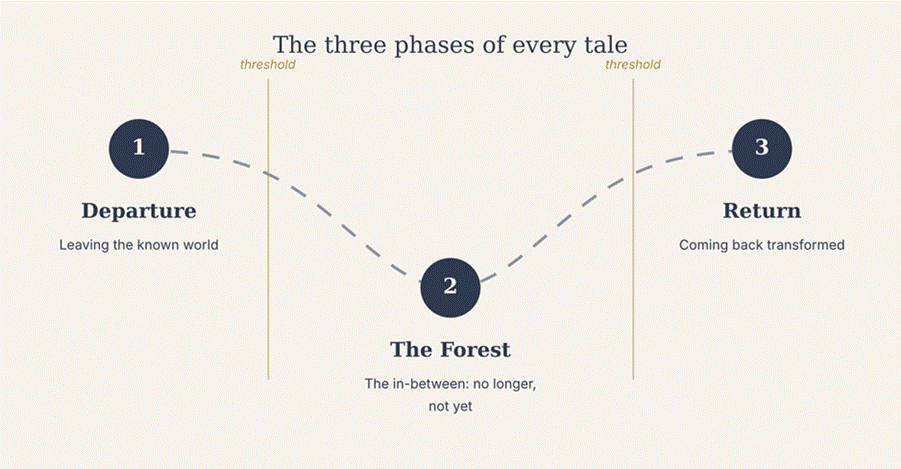
Symbolically, every tale crosses the same two thresholds: leaving the known world, and coming back transformed.
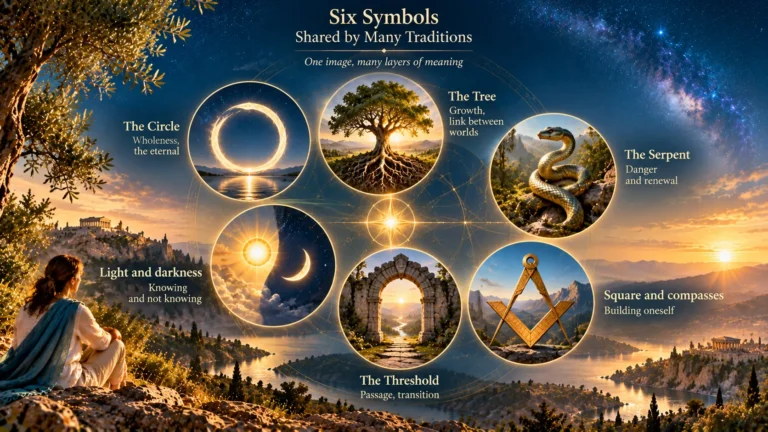
Myths and tales belong to the great wisdom traditions of humanity, alongside symbolism and shamanism, which draw much of their imagery from them. A myth tells a sacred story of origins: how the world began, why we die, where the gods came from. A tale tells a smaller story, often about an ordinary child or a youngest son who leaves home and comes back changed.
Their interest is twofold. Myths help us understand the world, because they show how each culture has explained what it could not control. Tales help us know ourselves, because their heroes face the same fears and choices we do: loss, exile, temptation, the need to grow up.
Long before psychology existed, these stories were how people learned what to expect when life changes direction. Let us look at myths and tales from five angles.
Where do myths and tales come from?
Myths are among the oldest texts we have. The Epic of Gilgamesh, written on clay tablets in Mesopotamia nearly four thousand years ago, tells of a king who loses his friend Enkidu and sets out to find immortality. He obtains a plant of youth, then loses it to a snake while he bathes, and returns home mortal but wiser.
Tales were passed on by word of mouth for centuries before anyone wrote them down. In France, Charles Perrault published his collection in 1697; in Germany, the Brothers Grimm published theirs in 1812. Both reworked stories that peasants, nurses and spinners were already telling.
Scholars began comparing these stories in the nineteenth century and were struck by their similarities. In 1909, the folklorist Arnold van Gennep showed that the rituals marking birth, adulthood, marriage and death share one structure in very different cultures. Many myths and tales follow that same structure.
What do myths and tales symbolize?
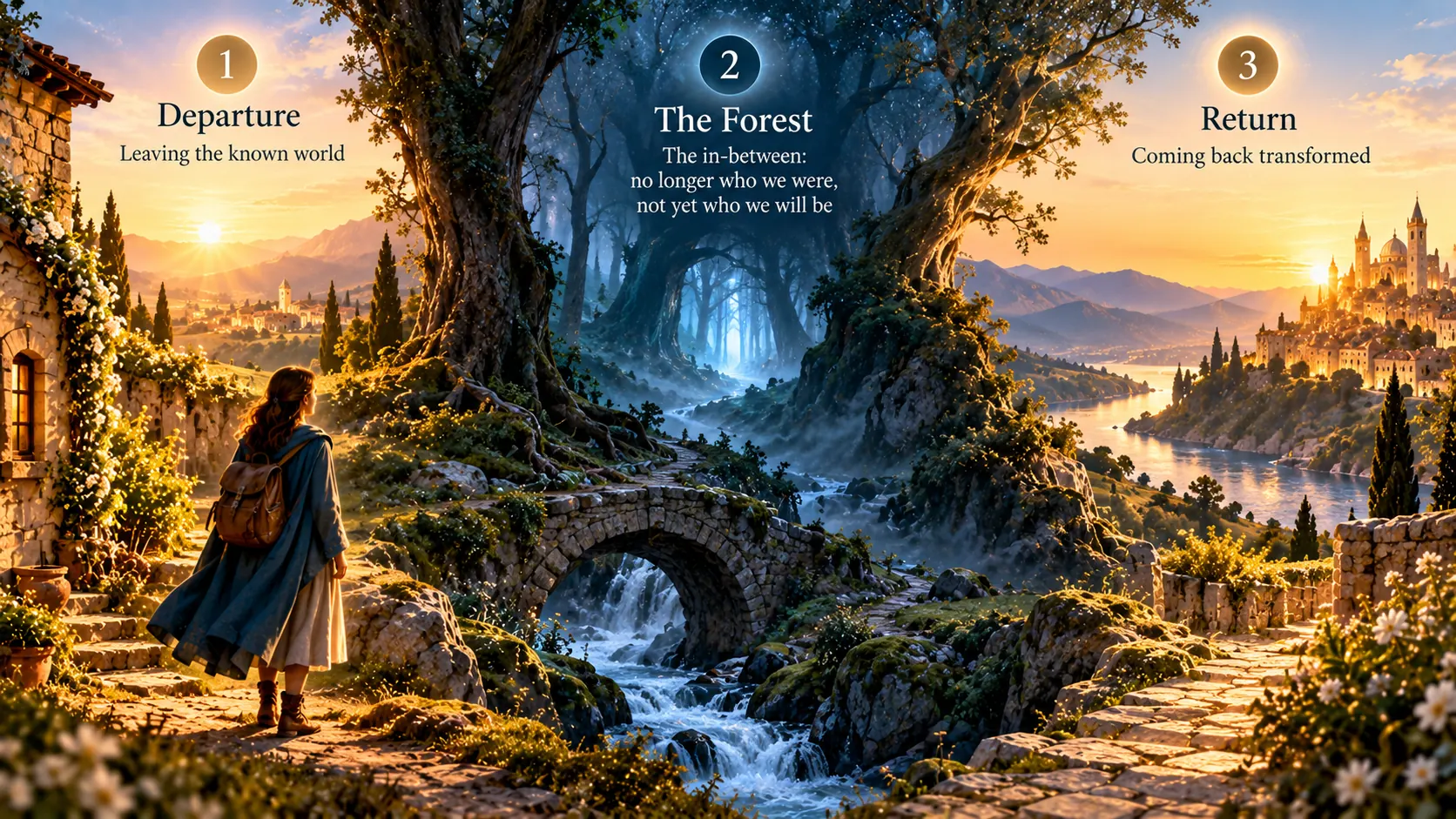
Symbolically, the places of a story are stages of the inner life. Home is the known world. The forest, the sea or the underworld is the unknown, where the old rules no longer apply. The return home, with a treasure or a bride, is a new way of being in the world.
Take Hansel and Gretel. Abandoned by their parents, the two children are lost in the woods, find a house made of bread and cake, and almost become the witch’s meal. Symbolically, the sweet house is the temptation to stay dependent, to be fed rather than to act. Gretel’s courage when she pushes the witch into the oven marks the moment the children stop waiting to be saved. They return home carrying jewels: what they bring back is their own capacity to act.
What do myths and tales teach about life’s passages?
In the mythic tradition, every real change has three phases. You leave; you go through a middle zone where you are no longer who you were and not yet who you will be; and you come back. Van Gennep called this middle zone the liminal phase, from the Latin limen, threshold. Joseph Campbell, comparing hero myths from many cultures, found the same arc and named it the hero’s journey: departure, initiation, return.
The lesson is simple and demanding: the middle is supposed to be uncomfortable. Jonah spends three days in the belly of a whale before being returned to land. Heroes are swallowed, lost or put to sleep before they are reborn.
Consider a woman who retires and moves to another country in her sixties. For a whole year she feels useless and foreign, and reads this as failure. The myths offer another reading: she is in the belly of the whale. Nothing is wrong; she is between two lives, and this phase has its own work to do. Finding meaning in such a passage is one expression of spiritual intelligence, and it is close to what existential psychology describes when old roles fall away.
What is the deeper meaning of myths and tales?
At a deeper level, the traditions do not treat myths as stories about someone else. The historian of religions Mircea Eliade argued that in traditional societies, telling a myth makes the time of origins present again: the listener does not learn about the creation, he takes part in it. This is a scholarly interpretation, not an experimental result.
Read this way, every character is a part of ourselves. The dragon guarding the treasure and the treasure itself belong together: what we fear most often hides what we most need. The descent is not a punishment but the condition of renewal, as in the blackening that opens the alchemical work. The twenty-two great cards of the tarot tell the same journey in images.
What does modern research say about myths and tales?
Research suggests that stories are not a luxury. A study of the Agta, a hunter-gatherer people of the Philippines, found that their tales carry messages about cooperation and equality, and that camps with skilled storytellers cooperated more (Smith et al., 2017). The authors propose that one function of storytelling may have been to organise cooperation. This is a hypothesis about origins, not a proven cause.
Psychology has also studied the stories we tell about our own lives. Research on narrative identity has found that people who find meaning in adversity, and who see themselves as agents in their life story, tend to report higher well-being (McAdams and McLean, 2013). These are associations; the researchers themselves note that cause and effect remain to be untangled. Transpersonal psychology explores the same territory from another angle. This research echoes an old intuition of the myths, that how we tell our story shapes how we live it, without confirming any particular tradition.
✦
In a nutshell
Myths and tales are humanity’s oldest maps of change. Myths explain the world; tales follow a hero who leaves, is tested and returns transformed. Read symbolically, they describe the passages we all go through, and remind us that the uncomfortable middle of a story is where change actually happens.
Practice: Your Story in Three Acts (10 minutes)
Take a sheet of paper, divide it into three columns, and answer slowly.
- Departure. What have you left, or what is leaving you? Name it in one sentence.
- The forest. What does the in-between feel like? Describe it as a place from a tale: a dark wood, a long sea crossing, a tower, the belly of a whale.
- Return. If this were a tale, what would the hero bring back? Write it as an object (a key, a lamp, a seed), then say what it stands for.
Finally, ask yourself: which character in your story is waiting to be saved, and which one is ready to act?
This is a reflective exercise, not therapy.
Quote
“Dream is the personalized myth, myth the depersonalized dream.” — Joseph Campbell, The Hero with a Thousand Faces (1949)
Sources
- Joseph Campbell, The Hero with a Thousand Faces, New World Library, 2008 (first published 1949).
- Mircea Eliade, Myth and Reality, Harper & Row, 1963.
- Dan P. McAdams and Kate C. McLean, “Narrative Identity,” Current Directions in Psychological Science, 22(3), 2013.
- Daniel Smith et al., “Cooperation and the Evolution of Hunter-Gatherer Storytelling,” Nature Communications, 8, 2017.
- Arnold van Gennep, The Rites of Passage, University of Chicago Press, 2019 (first published 1909).
Go deeper
The Awakening Journal — a free reflective workbook to deepen your spiritual intelligence.
Related articles
- What Is Alchemy? (Wisdom & Spirituality)
- Existential Psychology: Meeting the Great Questions of Life (Consciousness & Psychology)
- What Is Tarot? (Wisdom & Spirituality)
By Elizabeth Carrio, MSc in Consciousness and Transpersonal Psychology · Published October 18, 2026 · Last updated October 18, 2026 · Disclaimer