
What Is Symbolic Hypnosis?
Symbolic hypnosis uses images, stories and metaphors, rather than direct commands, to help a person look at an experience from a new angle. Where does it come from? Why can a bridge or a threshold speak to us more deeply than an explanation? And what can it offer someone going through a major change?
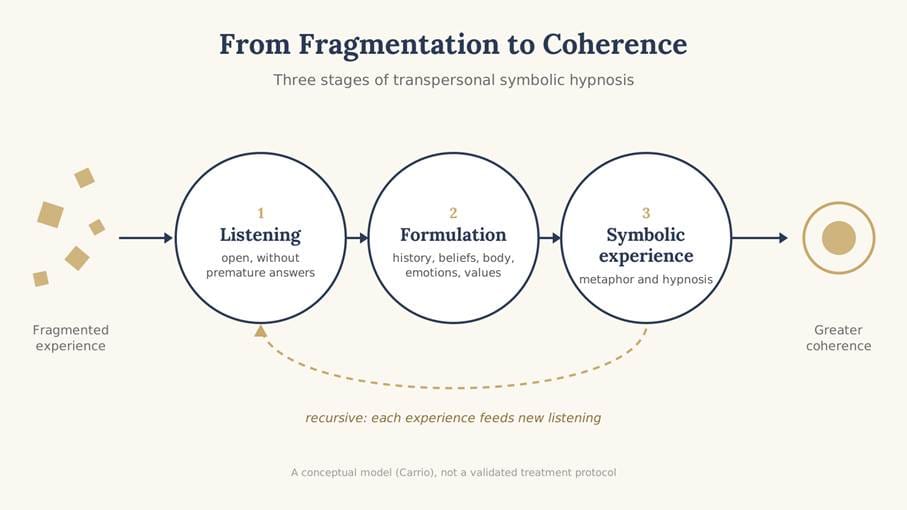
Symbolically, the work moves from scattered pieces of experience toward a more coherent whole.
Symbolic hypnosis is one of the applications of symbolism, the ancient art of reading images, myths and signs as carriers of meaning. It brings that art into a modern setting: a state of absorbed, focused attention in which a person can explore a metaphor from the inside rather than only think about it.
Its interest goes beyond the therapy room. Periods of transition, such as a separation, a retirement, a move abroad or a loss, often leave us with feelings, bodily reactions and questions that ordinary explanations no longer hold together. Understanding how symbols work in such moments helps us know ourselves and understand the world a little better.
This article belongs to the Symbolic Hypnosis section of the Consciousness & Psychology door; the symbolic traditions it draws on are explored in the Wisdom & Spirituality door. Let us look at symbolic hypnosis from five angles.
Where does symbolic hypnosis come from?
Modern hypnosis began in the eighteenth century with Franz Anton Mesmer’s “animal magnetism”, a theory rejected by a French royal commission in 1784. In the 1840s, the Scottish surgeon James Braid reframed the phenomenon as a matter of focused attention and popularized the word “hypnotism”.
The symbolic turn came in the twentieth century. The American psychiatrist Milton H. Erickson (1901–1980) rarely gave his patients direct orders: he told stories, used metaphors and worked with whatever the person brought. Meanwhile, Carl Jung showed how dreams and myths speak in images. Transpersonal psychology later brought these streams together, taking experiences of meaning and connection seriously while studying them with care. Symbolic hypnosis sits at this crossroads.
What does a symbol do in hypnosis?
Symbolically, an image can hold several things at once. A threshold can evoke a physical sensation, an emotion, a decision about a relationship and a question about the future, without forcing us to choose a single meaning.
That is why, in this approach, the metaphor is not imposed from outside. If someone keeps saying they feel “between two worlds”, the practitioner might offer an image of a bridge, a doorway or a landscape changing with the seasons. The person may find that the bridge stands for danger, freedom, grief or something no one expected. The value lies in that personal discovery. The practitioner moves from symbolic interpretation, telling people what an image means, to symbolic inquiry: asking what it means to them.
What does symbolic hypnosis teach about times of change?
Elizabeth Carrio’s framework, developed in her research on transpersonal symbolic hypnosis, starts from a simple observation: during a transition, distress is often less a breakdown than a sign that an old way of organizing life no longer fits. The question becomes not only “what is wrong?” but also “what is this experience asking me to reconsider?”, with a clear caveat: not every symptom hides a message.
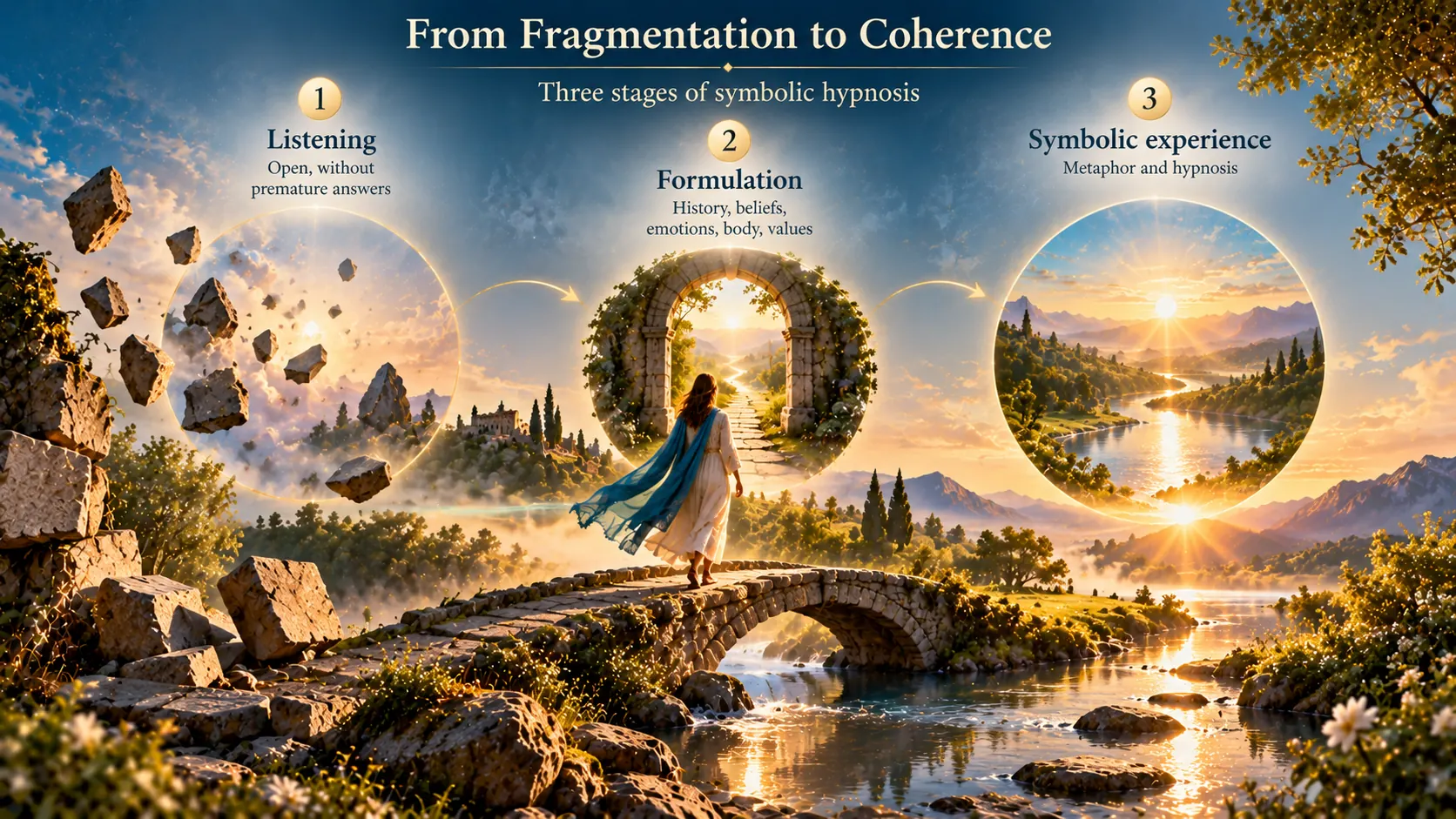
The framework proposes three stages. First, generative listening, a notion borrowed from Otto Scharmer’s Theory U: listening without filling the gaps with ready-made explanations. Then a formulation that connects history, beliefs, emotions, the body, relationships, values and the questions of meaning at stake. Only then comes the symbolic and hypnotic experience.
Take someone who has always felt that rest is dangerous. During an imaginative exercise, they may experience stillness not as giving up their responsibilities but as another form of activity. Understanding alone had not changed the habit; a lived image may open a door.
What is the deeper meaning of symbolic hypnosis?
At a deeper level, the framework describes a movement from fragmentation to coherence. It draws on a model of four intelligences, cognitive, emotional, somatic and spiritual, presented in Carrio’s book Awakening the Spiritual Mind. Coherence does not mean that thoughts, feelings, body and values always agree; it means that none of them silences the others.
Here, spiritual intelligence is not a supernatural faculty but an orientation toward meaning, values and purpose: a capacity to stay open in uncertainty. And the symbol is not a message from a hidden authority, waiting to be decoded. It is a meeting place where dimensions that ordinary language keeps apart can talk to one another. Traditions have long worked this way: in alchemy, darkness precedes the gold, giving change a shape without dictating its content.
What does modern research say about hypnosis?
Research on hypnosis itself is substantial. In 2015, the American Psychological Association’s Society of Psychological Hypnosis defined it as a state of consciousness combining focused attention, reduced peripheral awareness and an enhanced capacity to respond to suggestion (Elkins et al., 2015); other researchers dispute whether it is a distinct state at all. A Stanford brain-imaging study of 57 people (Jiang et al., 2017) found that, in highly hypnotizable participants, hypnosis was associated with reduced activity in a region linked to monitoring, and with changed connections between networks involved in attention, bodily awareness and self-reflection.
Research on interoception, our sense of the body’s inner states, also supports the role of the body in emotional life (Mehling et al., 2012). The three-stage framework, however, is a theoretical model, not a validated treatment. Whether symbolic work increases meaning or coherence remains an open research question.
In a nutshell
Symbolic hypnosis is one of the applications of symbolism to inner life: it uses metaphor and focused attention so that a person can explore an experience from the inside. Rather than decoding symbols, it lets them become bridges between thought, feeling, body and meaning, especially in times of transition.
Practice: The Threshold Image (8 minutes)
Sit comfortably, eyes open or closed, and take a few slow breaths.
- Think of a change you are living through. Notice the words you use for it: stuck, lost, between, opening…
- Let an image arise that matches those words: a door, a bridge, a path, a season. Do not choose it; notice it.
- Explore it for a few minutes. Where are you in the image? What lies on the other side? What does your body feel?
- Write down three words the image leaves you with.
Then ask yourself: what does this image show me that my explanations did not? If strong distress arises, stop and return to your breath. This is a reflective exercise, not therapy.
Quote
“The symbol is not primarily a message from an unconscious authority but a medium through which meaning can be explored.” — Elizabeth Carrio, From Fragmentation to Coherence (2026)
Sources
- Erickson, Milton H., and Ernest L. Rossi. Hypnotherapy: An Exploratory Casebook. Irvington Publishers, 1979.
- Elkins, Gary R., Arreed F. Barabasz, James R. Council, and David Spiegel. “Advancing Research and Practice: The Revised APA Division 30 Definition of Hypnosis.” International Journal of Clinical and Experimental Hypnosis 63, no. 1 (2015).
- Jiang, Heidi, Matthew P. White, Michael D. Greicius, Lynn C. Waelde, and David Spiegel. “Brain Activity and Functional Connectivity Associated with Hypnosis.” Cerebral Cortex 27, no. 8 (2017).
- Kasprow, Mark C., and Bruce W. Scotton. “A Review of Transpersonal Theory and Its Application to the Practice of Psychotherapy.” Journal of Psychotherapy Practice and Research 8, no. 1 (1999).
- Scharmer, C. Otto. Theory U: Leading from the Future as It Emerges. Berrett-Koehler, 2009.
Go deeper
- The Awakening Journal — a free reflective workbook to deepen your spiritual intelligence.
Related articles
- What Is Symbolism? (Wisdom & Spirituality)
- What Is Transpersonal Psychology? (Consciousness & Psychology)
- What Is Spiritual Intelligence? (Consciousness & Psychology)