What Is the Philosopher’s Stone?
Alchemy’s most famous symbol, the long history behind it, and what it still has to say to anyone engaged in inner work.
Ask most people what the Philosopher’s Stone is and you will hear some version of the same answer: a magical substance, usually red, that turned lead into gold and perhaps granted eternal life. Harry Potter made the idea familiar to a whole generation, but the image is much older. Medieval and Renaissance alchemists encouraged it themselves. Some of them truly believed in it. Others found it a convenient cover for work they preferred not to explain to the Church or to curious princes.
There is another way of reading the alchemists, and it is almost as old as their furnaces. In this reading, the gold they were after was a quality of the human being, and the “stone” was the person who had been changed by the work. The rough stone you start with and the Stone you end with are made of the same material. What has changed is its state.
This idea is the thread of the article. We will follow the Philosopher’s Stone from the workshops of Roman Egypt to the psychology of Carl Jung, look at how the alchemists pictured it, and see how the same image of a stone waiting to be shaped resurfaced in other Western traditions. No prior knowledge is needed, only some curiosity about what the old seekers were really looking for.
Where does the idea come from?
Alchemy did not begin in a wizard’s tower. As far as historians can tell, it began in the workshops of Roman Egypt, where metalworkers, dyers and makers of imitation gems knew a great deal about how materials change color and texture under heat. Around the year 300, a Greek-speaking Egyptian named Zosimos of Panopolis wrote long treatises that combined this practical knowledge with religious and philosophical ideas. He described what happened in the flask as a death and resurrection of matter, and he already treated the transformation of metals as a mirror of the transformation of the soul. Greek alchemical texts of this period speak of “the stone that is not a stone,” a phrase that would echo for the next fifteen centuries.
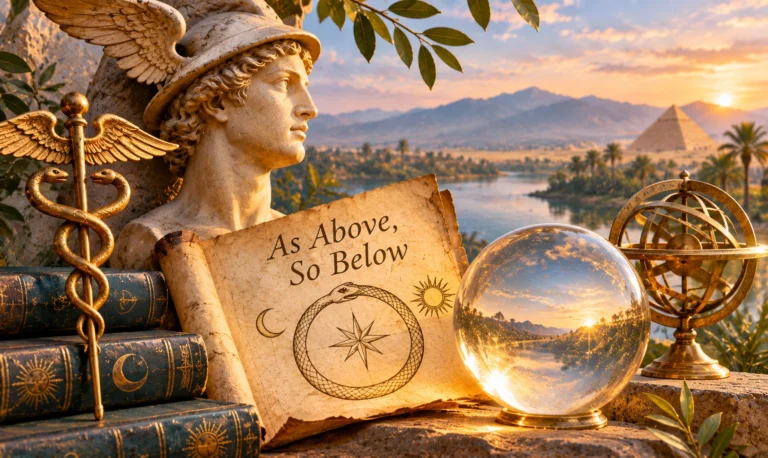
When Alexandria came under Arab rule in the seventh century, Greek learning passed into Arabic. Scholars in Baghdad and elsewhere translated it, expanded it and organized it. A large body of writings attributed to Jābir ibn Hayyān taught that all metals are made of two principles, sulfur and mercury, mixed in different proportions. Adjust the proportions and you could, in theory, perfect any metal. The substance that would do the adjusting was called al-iksīr, which gave us the word “elixir.” It is also in Arabic that we first find the short and enigmatic text known as the Emerald Tablet, attributed to the legendary sage Hermes Trismegistus. Its best-known line, “as above, so below,” became the motto of the whole tradition.
Europe learned alchemy from these Arabic sources. In 1144 an Englishman, Robert of Chester, working in Spain, completed the first Latin translation of an alchemical treatise. In his preface he remarked that the Latin world did not yet know what alchemy was. Within a century it did, and Latin writers were speaking of the lapis philosophorum, the “stone of the philosophers.” The name stuck.
The sixteenth and seventeenth centuries were alchemy’s golden age, and also the period when its spiritual reading came into the open. The Swiss physician Paracelsus added a third principle, salt, to sulfur and mercury, and turned alchemy toward medicine and the inner life. In 1614 the first of the Rosicrucian manifestos appeared in Germany, announcing a secret brotherhood devoted to the reform of knowledge. The third of these texts, The Chymical Wedding of Christian Rosenkreutz (1616), is an alchemical allegory from beginning to end. A year later the court physician Michael Maier published Atalanta Fugiens, a book of fifty emblems, each with an engraving, a motto, a short poem and a piece of music. We will come back to one of those engravings.
One figure of the period links alchemy to another Western tradition: Elias Ashmole. An antiquarian, astrologer and committed alchemist, Ashmole wrote in his diary that on October 16, 1646, he was “made a Free Mason at Warrington,” in Lancashire. It is one of the earliest recorded initiations of a man who was not a working stonemason. Six years later he published Theatrum Chemicum Britannicum, a large collection of English alchemical poetry. The gentlemen who joined the early lodges often moved easily between the language of the builders and the language of the alchemists, and Ashmole is the clearest example.
Even Isaac Newton belongs in this story. He wrote more than a million words on alchemy, almost all of them in private, and made his own translation of the Emerald Tablet. When the economist John Maynard Keynes bought a large share of these papers at auction in 1936, he concluded that Newton “was not the first of the age of reason. He was the last of the magicians.”
The last great turn came in the twentieth century. The Swiss psychiatrist Carl Gustav Jung noticed that the images in old alchemical books looked remarkably like the dreams of his patients. In Psychology and Alchemy (1944) he argued that the alchemists had been projecting an inner process onto their flasks. Many historians of science now think Jung underestimated how real the alchemists’ chemistry was. His reading nevertheless opened the door to the psychological interpretation that most people encounter today.
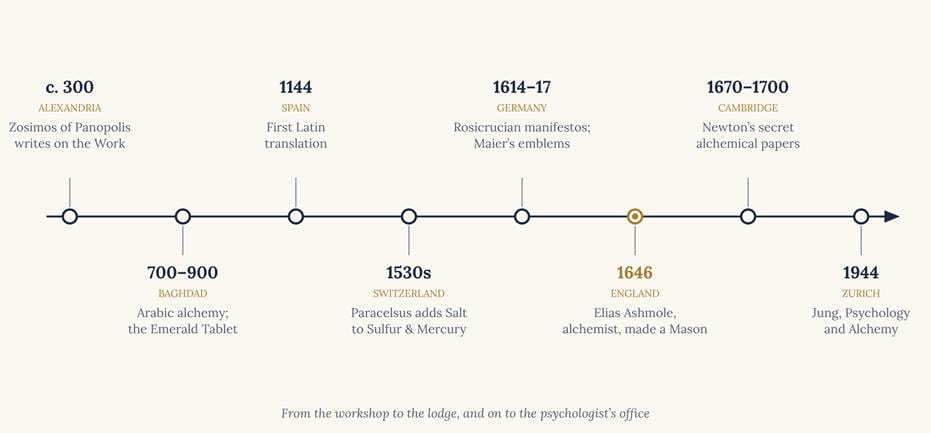
From Roman Egypt to Jung’s Zurich: more than sixteen centuries of alchemy.
What did the alchemists mean by “stone”?
Spiritual alchemy gives a precise answer: the Philosopher’s Stone is the completed human being. It describes a state in which a person’s physical, emotional and spiritual lives have stopped pulling in different directions and begun to work as one.
To see why this was called a stone, start with lead. In the alchemical system each metal was paired with a planet, and lead belonged to Saturn, the slowest, darkest and most distant of the planets known in antiquity. Saturn stood for density, limitation, time and the weight of material life. A person who lives entirely at that level, absorbed by survival, habit and appetite, is the “lead” of the work. Yet the alchemists said that gold lies hidden inside Saturn. The gold does not have to be brought in from outside. It is already there, under the weight.
This is why the tradition speaks of two stones. The ordinary, or rough, stone is the person before the work, whose deeper nature is present but asleep. The Philosopher’s Stone is the same person after the work. Nothing has been added. The alchemists insisted that the entire process takes place in a single sealed vessel, heated slowly in a furnace they called the athanor. Applied to a human life, the image is plain enough: you are both the material and the vessel, and no one else can do the work for you.
Gerhard Dorn, a sixteenth-century physician and a follower of Paracelsus, compressed all of this into one sentence, printed in the great alchemical anthology Theatrum Chemicum in 1602:
Transform yourselves from dead stones into living philosophical stones!
— Gerhard Dorn, Theatrum Chemicum (1602)
The image of the “living stone” is older than alchemy, and it traveled well beyond it, as we will see later in this article.
One more point is often misunderstood. Spiritual alchemy does not ask anyone to escape the body or to despise the material world. Its aim runs the other way: to give spirit a body and to bring matter to life. The Emerald Tablet says of the mysterious “one thing” at the center of the work that “its force or power is entire if it be converted into earth,” to quote Newton’s translation. In this tradition the Philosopher’s Stone is not a soul that has left the world behind. It is a soul that has fully arrived in it.
How do you read the symbol of the Philosopher’s Stone?
Alchemists rarely explained themselves directly. They taught through pictures, and the best-known picture of the Philosopher’s Stone is a geometric one. In Emblem XXI of Atalanta Fugiens, Maier shows a philosopher holding a pair of compasses and tracing a figure on a wall. The motto beneath it reads: “Make a circle out of a man and a woman, from it a square, from this a triangle; make a circle and you will have the Philosopher’s Stone.”
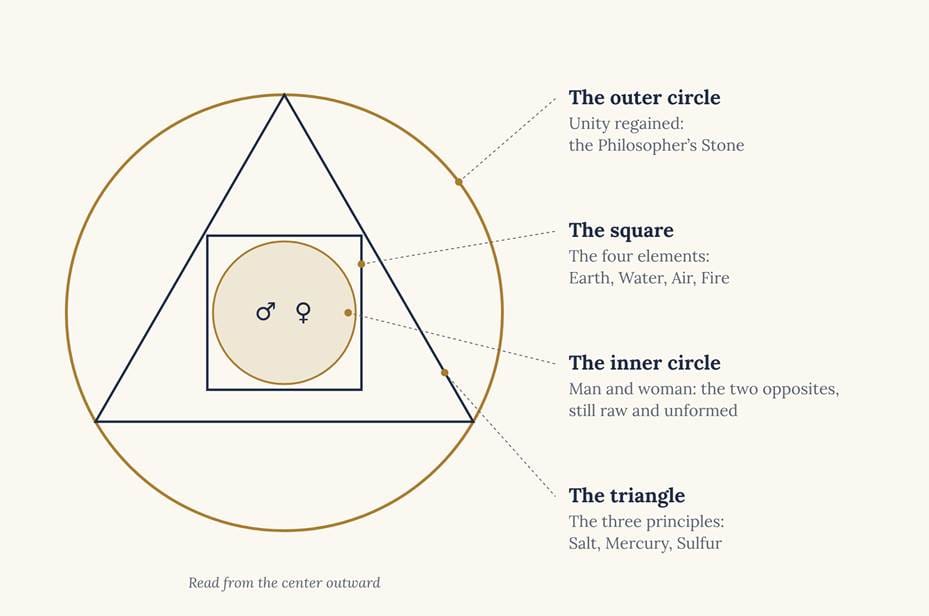
The figure of the Stone, after Michael Maier, Atalanta Fugiens, Emblem XXI (1617).
The figure is meant to be read from the center outward. The inner circle holds the man and the woman, the two opposite forces of nature that the alchemists called Sol and Luna, the sun and the moon. At this point they sit side by side without being united: this is raw material, a little like the chaos at the beginning of the world. The square stands for the four elements of ancient physics, earth, water, air and fire, which is to say the world of matter with its order and its limits. The triangle stands for the three principles of Paracelsus, salt, mercury and sulfur, which correspond roughly to body, soul and spirit. The outer circle then gathers everything into a new unity. The opposites of the first circle meet again, but now every part has found its place.
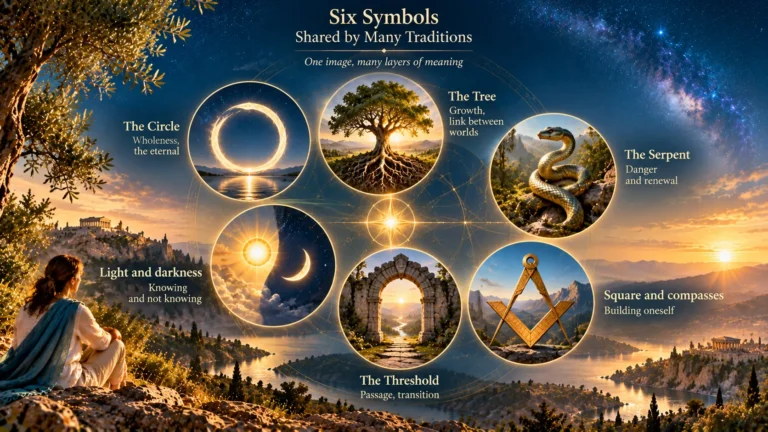
Notice one detail: the figure is drawn with compasses, the instrument of the architect. In the symbolic language of the period, the circle evokes heaven and the spirit, while the square evokes the earth and the way we conduct ourselves on it. The Stone is the place where the two meet. The same pairing of compasses and square would later become the emblem of the Freemasons.
Other traditions pictured the same idea in their own way. Sufi writers used “red sulfur” as a name for something so rare it is almost never found, namely the perfected human being. Chinese alchemists worked with cinnabar, a red ore of mercury, and their inner alchemy placed a “field of cinnabar” inside the human body. European books show the Stone as a crowned child dressed in red or purple, as a pelican feeding its young with its own blood, as a phoenix rising from its ashes, or as an androgyne, a single figure that unites male and female. Christian alchemists compared it to the risen Christ. Behind all these images lies one pattern: something has to die before something more complete can be born.
What are the three stages of the Work?
The alchemists described the making of the Philosopher’s Stone as a series of color changes in the flask. The number of stages varies from one author to another, but most later texts reduce them to three: black, white and red.
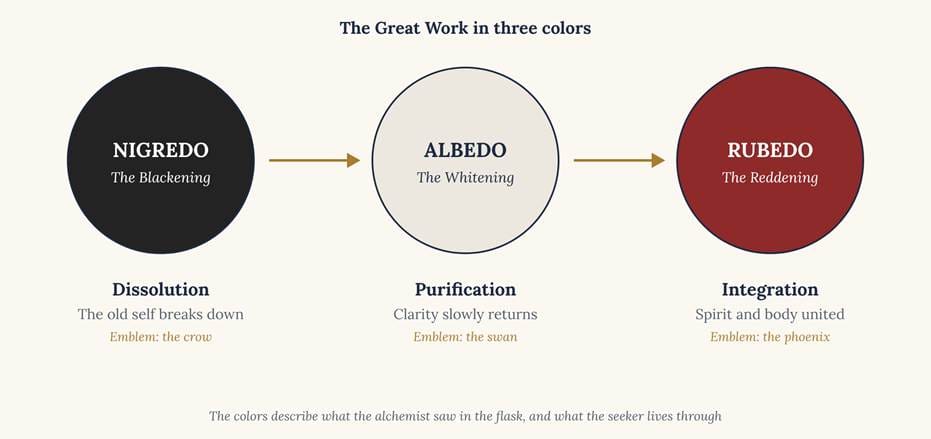
The three classical stages of the Great Work.
The first stage is the nigredo, or blackening. The material in the flask is heated until it rots, breaks down and turns black. The alchemists called this putrefaction and gave it the crow as its emblem and Saturn as its planet. In a human life, the nigredo is the time when old certainties stop working. A career ends, a marriage ends, a belief no longer holds, or a person simply wakes one morning unable to go on as before. It is painful, and the tradition never pretends otherwise. What it insists on is that the blackening is not a failure of the work. It is where the work begins, because nothing new can be built from a structure that refuses to come apart.
The second stage is the albedo, or whitening. The black mass is washed, again and again, until it becomes pale and clear. Symbolically, the spirit that was set free during the first stage returns to the body, now purified. Its emblem is the swan or the white dove, and its planet is the Moon. In psychological terms, this is the period of clarity that can follow a crisis, when a person starts to see what really matters and to live more honestly. The old texts speak of a “glorified body”: physical life is no longer an obstacle to awareness but the place where awareness shows itself.
The third stage is the rubedo, or reddening. Gentle heat is applied once more, and the white substance turns red. This is the completion of the work, pictured as a king, a red lion or a phoenix. Fire and water, spirit and body, are no longer at odds. A person at this stage lives fully in the world, with work, relationships and responsibilities, while staying in touch with a deeper source. The alchemists called the result the Red Stone. We might simply say that the person has become whole.
It is worth adding that the tradition never described this as a single, tidy progression. The cycle repeats. Anyone who has lived long enough will recognize more than one blackening, and more than one whitening, in their own history.
What was the Philosopher’s Stone supposed to give?
The old books credit the Stone with astonishing powers. It cures every disease and prolongs life. It lets its owner appear in several places at once, become invisible, or see God face to face. These claims belong to the legendary layer of alchemical literature and should be read that way. They tell us what people longed for, not what anyone ever observed.
Read as symbols, the gifts of the Stone are more modest and, in the end, more interesting. The first is wisdom, understood less as learning than as freedom from rigid certainty: the ability to see past one’s habits and conditioning. The second is serenity, a steadiness that does not depend on circumstances and has nothing to do with indifference. The third is a kind of immortality. In spiritual alchemy this rarely means living forever in the body. It means losing the fear of death because one has found, within oneself, something that time does not touch. The Greek word gnosis, direct knowledge as opposed to knowledge gathered from books, is often used for this state.
Christian alchemists compared the finished Stone to a return to Eden, to the harmony that existed before the separation. Whatever language one prefers, the idea is the same. What the work produces is not something new. It is something recovered.
Where else does the image of the stone appear?
Alchemy was not the only tradition to picture the human being as a stone waiting to be shaped. The idea runs through the Bible, from “the stone which the builders refused,” which becomes the cornerstone (Psalm 118), to the First Epistle of Peter: “Ye also, as lively stones, are built up a spiritual house” (1 Peter 2:5). This is exactly the image Gerhard Dorn used when he urged his readers to turn dead stones into living ones.
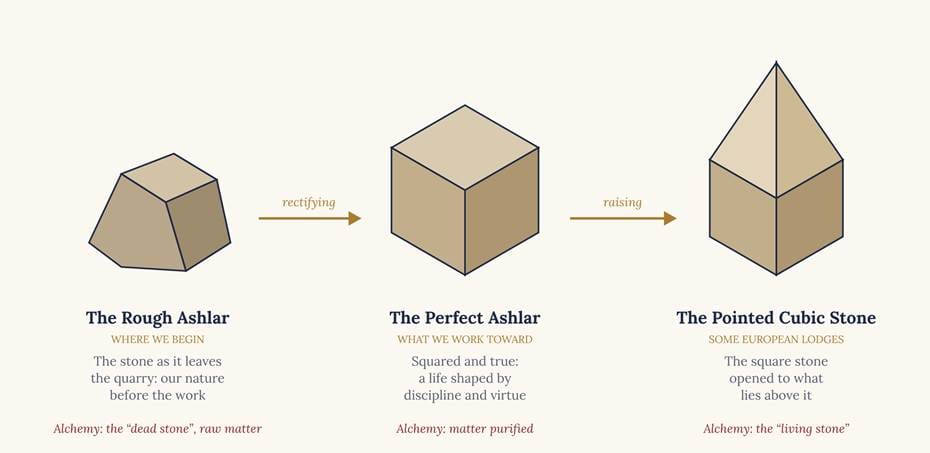
The image of the stone in Freemasonry, and its alchemical counterparts.
Freemasonry, which took shape in Britain in the seventeenth century, placed this image at the center of its symbolism. Its lodges borrowed the tools and vocabulary of the medieval cathedral builders, and they attracted men like Elias Ashmole who had read the alchemists. Two stones are shown to every new member. The rough ashlar is a block as it comes from the quarry, and it stands for our nature before any work has been done on it. The perfect ashlar is the same block once it has been squared and smoothed, and it stands for a person shaped by discipline and reflection.
An alchemist would have recognized the pair at once. The rough ashlar is the prima materia, the “dead stone” of Gerhard Dorn. The perfect ashlar is the stone that has been worked. In both traditions the work is slow and repetitive, and it is done by the person upon themselves.
Some lodges, mostly in Europe, go further and use openly alchemical symbols. Before admission, the candidate waits in a small dark room called the Chamber of Reflection. It usually contains a skull, bread and water, an hourglass, and small dishes of salt and sulfur, two of the three alchemical principles. On the wall is the word VITRIOL, an acronym for a Latin sentence that first appeared in alchemical books of the early seventeenth century: Visita Interiora Terrae Rectificando Invenies Occultum Lapidem, “Visit the interior of the earth; by rectifying, you will find the hidden stone.” Vitriol was also the name of a real substance, a corrosive acid the alchemists used to dissolve metals. The double meaning is intended. The way to the hidden stone leads down into oneself, and it requires letting certain things dissolve.
The same lodges use a third stone as well: the pointed cubic stone, a perfect cube crowned with a small pyramid. The cube stands for stability and right conduct in the world, the point for what rises above it. Together they express the same union of earth and heaven that Maier drew as a circle around a square.
What matters here is not any particular organization but the persistence of the image. For more than fifteen centuries, seekers who had very little else in common described inner work in the same terms: a raw stone, patient labor, and a stone that slowly comes to life.
What does the Philosopher’s Stone mean for us today?
The Philosopher’s Stone is not buried in a cave or locked in a museum. In the language of the tradition it is hidden in plain sight, inside the person who is looking for it. The alchemists spent their lives at the furnace because they believed that real change takes time, patience and repeated effort. Few people who have ever tried to change a deep habit would disagree.
For anyone who has started to look inward, the lesson is both simple and demanding. The rough stone is nothing to be ashamed of: it is the material of the work. No one can do that work in your place, and no one can sell you the Stone. What the old texts offer is a map, and the quiet reassurance that others have walked this way before.
Sources
- Eliade, Mircea. The Forge and the Crucible: The Origins and Structure of Alchemy. University of Chicago Press, 1978.
- Jung, C. G. Psychology and Alchemy. Collected Works, vol. 12. Princeton University Press, 1968.
- Principe, Lawrence M. The Secrets of Alchemy. University of Chicago Press, 2013.
- Dobbs, Betty Jo Teeter. The Foundations of Newton’s Alchemy. Cambridge University Press, 1975.
- Maier, Michael. Atalanta Fugiens. Oppenheim, 1617.
- MacNulty, W. Kirk. Freemasonry: Symbols, Secrets, Significance. Thames & Hudson, 2006.
By Elizabeth Carrio, MSc in Consciousness and Transpersonal Psychology, November 2026