What Are Personal Values?
Personal values are what matters most to us, the quiet compass behind our choices. But where do they come from? Why do two good values sometimes pull us in opposite directions? And what happens to our values when life changes around us?
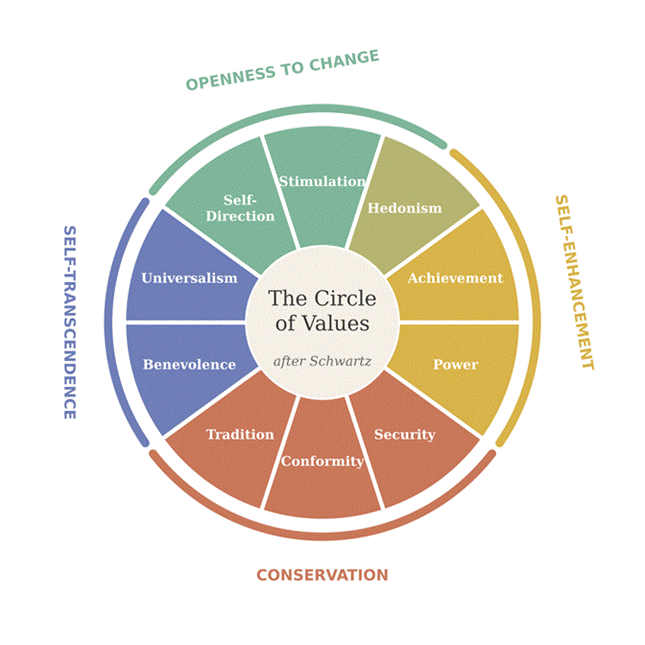
Symbolically, the circle shows that every value has a neighbour it agrees with and an opposite it competes with.
Personal values are one of the fields of the Consciousness & Psychology door, at the crossroads of social psychology, personality psychology and cross-cultural research. They describe what each of us considers important in life: security or adventure, success or kindness, tradition or freedom.
Values are not the same as personality traits. A trait describes how we tend to behave; a value describes what we find worth pursuing. Someone can be shy and still value adventure, or be ambitious by temperament and value humility. Understanding our values helps us know ourselves, and it also helps us understand why other people, and whole societies, make the choices they make.
Most of the time, our values work silently in the background of our consciousness. They come to light when a decision forces two of them into conflict: a job offer abroad, a move, a retirement, a separation. Let us look at personal values from five angles.
Where does the psychology of values come from?
Values were central to the founders of the social sciences. The sociologists Émile Durkheim and Max Weber saw them as the key to explaining how societies hold together and change. In 1973, the American psychologist Milton Rokeach published a list of 36 values that people could rank in order of importance, which opened the way to measuring them.
The decisive step came from Shalom H. Schwartz, at the Hebrew University of Jerusalem. From 1982 onwards, he looked for a set of values that people in all cultures would recognize. Research on samples from 82 countries has found ten basic values, each distinguished in at least 90% of the samples studied (Schwartz, 2012). This is a scientific result, built on two questionnaires, the Schwartz Value Survey and the Portrait Values Questionnaire. In the second, people simply say how much they resemble short portraits, such as a person for whom “thinking up new ideas and being creative is important.”
What do the ten values mean?
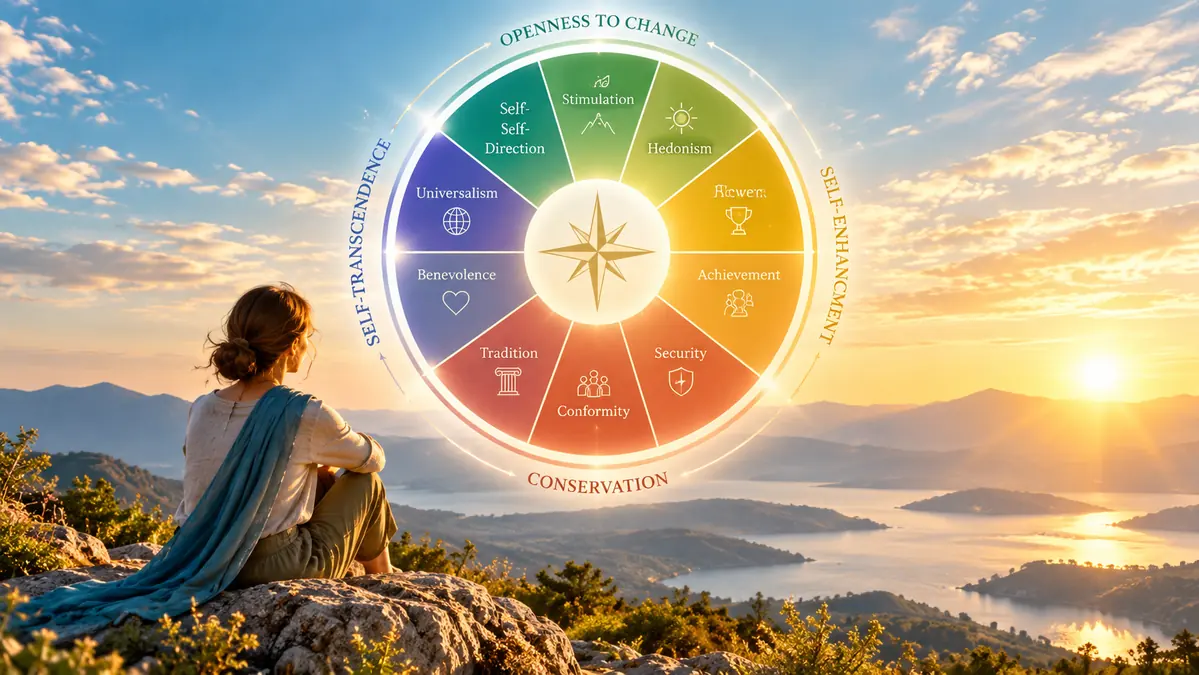
Each value expresses a different motivation. Self-direction is the wish to think and act independently; stimulation, the taste for novelty and challenge; hedonism, the search for pleasure. Achievement seeks success recognized by others, and power seeks status and control over resources. Security protects stability, conformity restrains what might upset others, and tradition respects the customs we have inherited. Benevolence cares for those close to us, while universalism extends that care to all people and to nature.
Symbolically, the circle is a map of motivations rather than a list of virtues. Neighbouring values share a goal: honesty and loyalty both express benevolence, and they rarely conflict. Opposite values compete: the person who craves novelty and the person who cherishes routine are standing on opposite sides of the same wheel.
What do our values teach us about difficult choices?
In Schwartz’s theory, values become conscious when a choice has opposite consequences for two values we hold dear. No single act can satisfy them all, but we can honour competing values at different times and in different places.
Consider Anne, 62, who is offered early retirement and dreams of settling by the sea in another country. Self-direction and stimulation push her to go. Security, and the benevolence she feels towards her grandchildren, hold her back. Seen through the circle, her hesitation is not weakness: it is the visible sign of two families of values pulling in opposite directions. Naming them helps her move from “I cannot decide” to “what do I want to protect, and what do I want to open?”
As early as 1950, the psychologist Werner Wolff described personal crisis as the moment when a person’s values are put at stake, an idea later developed by existential psychology. This is an interpretation, not an experimental result.
Do wisdom traditions speak of opposing forces?
Long before psychology drew its circle, wisdom traditions described a similar tension between expanding and restraining. In the Kabbalah, the Tree of Life sets Chesed (loving-kindness, the force that gives and expands) against Gevurah (strength, the force that limits), and places their balance in Tiferet (beauty, harmony). Kabbalistic psychology reads this triad as a map of inner life. In alchemy, the formula solve et coagula (dissolve and bind) expresses the same rhythm of opening and consolidating.
These are echoes, not confirmations: the traditions and the research speak different languages. One detail is striking, however. Schwartz tested spirituality as an eleventh universal value and dropped it, because its meaning was not consistent across cultures. One hypothesis, explored in transpersonal psychology and in research on spiritual intelligence, is that spirituality may be less one value among others than a way of holding them all together.
What does modern research say about personal values?
Research on personal values has found that what people say is important to them predicts a wide range of attitudes, preferences and actual behaviours (Sagiv, Roccas, Cieciuch and Schwartz, 2017). Across most countries studied, benevolence, universalism and self-direction rank highest on average, while power and stimulation rank lowest (Schwartz, 2012). The model has since been refined into 19 narrower values for more precise prediction (Schwartz and colleagues, 2012).
Research on life transitions has found that values are both a cause and a consequence of change. In three longitudinal studies of people who chose a new path, from police training to university studies and migration, values often fitted the new situation from the start; they changed more clearly when many aspects of life changed at once, as in migration (Bardi and colleagues, 2014).
In a nutshell
Personal values are the goals we consider important as guiding principles in life. Psychology describes ten of them, arranged in a circle where neighbours agree and opposites compete. Knowing our own order of priorities helps us understand our choices, and live a transition more consciously.
Practice: Your Circle of Values (10 minutes)
Take a sheet of paper, look at the circle above, and answer in writing.
- Choose the three values that matter most to you today, and the one that matters least.
- Think of a decision you are facing. Note which of your values it serves and which it puts at risk.
- Find these values on the circle. Are they neighbours, or do they face each other?
- Ask yourself: at another moment or in another place, how could I honour the value this decision leaves aside?
This is a reflective exercise, not therapy.
“Values are beliefs linked inextricably to affect.” — Shalom H. Schwartz, 2012
Sources
- Schwartz, S. H., An Overview of the Schwartz Theory of Basic Values, Online Readings in Psychology and Culture, 2012.
- Schwartz, S. H., et al., Refining the Theory of Basic Individual Values, Journal of Personality and Social Psychology, 2012.
- Sagiv, L., Roccas, S., Cieciuch, J., and Schwartz, S. H., Personal Values in Human Life, Nature Human Behaviour, 2017.
- Bardi, A., et al., Value Stability and Change During Self-Chosen Life Transitions, Journal of Personality and Social Psychology, 2014.
- Rokeach, M., The Nature of Human Values, Free Press, 1973.
Go deeper
The Awakening Journal — a free reflective workbook to deepen your spiritual intelligence.
Related articles
- Existential Psychology: Meeting the Great Questions of Life (Consciousness & Psychology)
- What is Kabbalistic psychology? (Consciousness & Psychology)
- What Is Tarot? (Wisdom & Spirituality)
By Elizabeth Carrio, MSc in Consciousness and Transpersonal Psychology · Published October 17, 2026 · Last updated October 17, 2026 · Disclaimer