
What Is Esotericism?
Esotericism is not a secret doctrine hidden from the many, but a family of traditions that, for two thousand years, have sought knowledge through symbols and inner experience. Where does it come from? Why do alchemy, Kabbalah and tarot keep meeting in its history? And what can it offer a modern, critical mind?
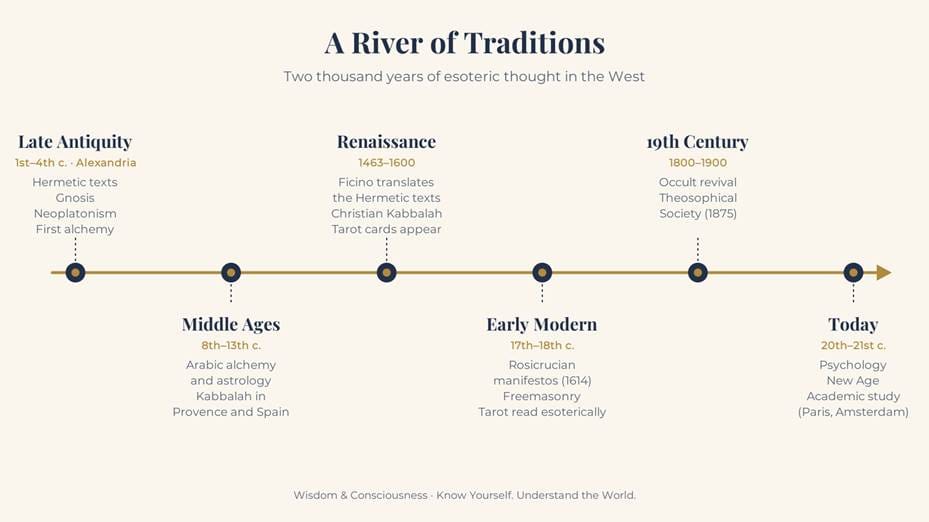
Symbolically, esoteric thought is a river: each tradition flows into the next, and none starts from nothing.
The history of esoteric thought is the thread that runs through the great esoteric traditions of the West: Hermeticism, Gnosis, alchemy, Kabbalah, astrology and tarot. Scholars call this family “Western esotericism”, although it constantly borrowed from Egyptian, Jewish and Islamic sources, and later from Asian ones.
The word comes from the Greek esōterikos, “belonging to the inner circle”. The noun “esotericism” is surprisingly recent: it only appeared in French in the early nineteenth century. What it names, however, is ancient: the conviction that the world has a hidden depth, and that to know it, the knower must change.
Following this history is a way of practicing both halves of our motto: know yourself, understand the world. It shows where many of our ideas about the soul, symbols and inner growth actually come from. Let us look at esoteric thought from five angles.
Where does esoteric thought come from?
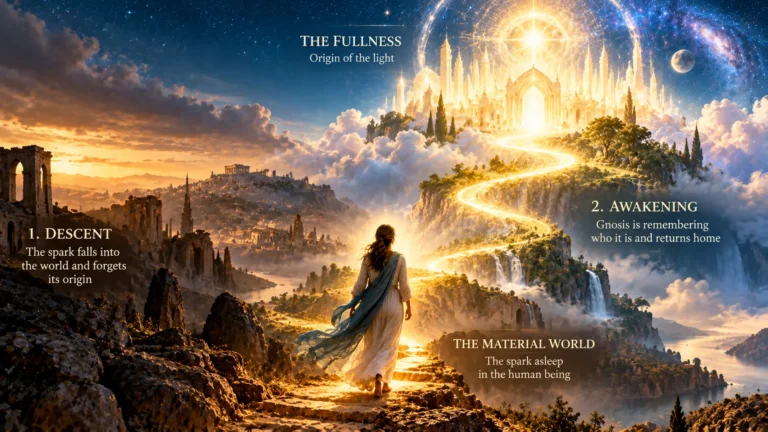
Most historians trace its roots to Alexandria and Roman Egypt in the first centuries of our era, where Greek philosophy, Egyptian religion and Jewish thought met. This blend produced the Corpus Hermeticum, a collection of dialogues attributed to the legendary sage Hermes Trismegistus, along with Gnostic texts, Neoplatonic philosophy and the first alchemical treatises.
In the Middle Ages, much of this heritage survived through Arabic scholars, while Kabbalah took shape in Provence and Spain in the twelfth and thirteenth centuries. A decisive moment came in Florence in 1463: Cosimo de’ Medici asked the philosopher Marsilio Ficino to set aside his translation of Plato and translate the Hermetic texts first, because they were believed to be older and wiser. New currents followed: Christian Kabbalah, the Rosicrucian manifestos (1614–1616), esoteric Freemasonry, the occult revival of the nineteenth century, the Theosophical Society (New York, 1875) and, much later, the New Age.
What does esoteric thought symbolize?
Symbolically, esoteric thought treats the world as a book written in a language of correspondences. Historian Antoine Faivre identified a few features shared by most of these currents: hidden links between all levels of reality, a nature seen as alive, a central role for imagination and images, and the hope of an inner transformation.
A simple example makes this concrete. In the Renaissance, the Sun corresponded to gold, to the heart, to the lion and to the color yellow. A physician-philosopher could therefore read a sunflower, a metal and a mood as expressions of one principle. In such a world, nothing is merely itself; everything points beyond itself, as words point to meaning. This is why symbols, rather than arguments, are the native language of these traditions.
What does esoteric thought teach about knowing yourself?
In the esoteric traditions, true knowledge is not information but transformation: you do not simply learn something, you become someone able to see it. The Hermetic texts, like the old inscription at Delphi, invite the reader to know themselves in order to know the world.
Take a woman in her fifties who keeps meeting the same conflict, each time with a new manager. She can treat every episode as bad luck. Or she can read the series as a text: what keeps repeating, and what is it asking her to understand? She notices that she reacts to authority as she once did at home, and begins to respond differently. Nothing magical has happened; she has used the esoteric habit of reading events as meaningful, without giving up her judgment.
Many esoteric authors also distinguished two kinds of seekers: one hungry for marvels, the other ready to be changed. Discernment is what separates them.
What is the hidden meaning of “esoteric”?
At its deepest level, “hidden” does not mean “forbidden”. In this tradition, a teaching is esoteric because it can only be understood from the inside, through experience, just as a melody can only be known by listening.
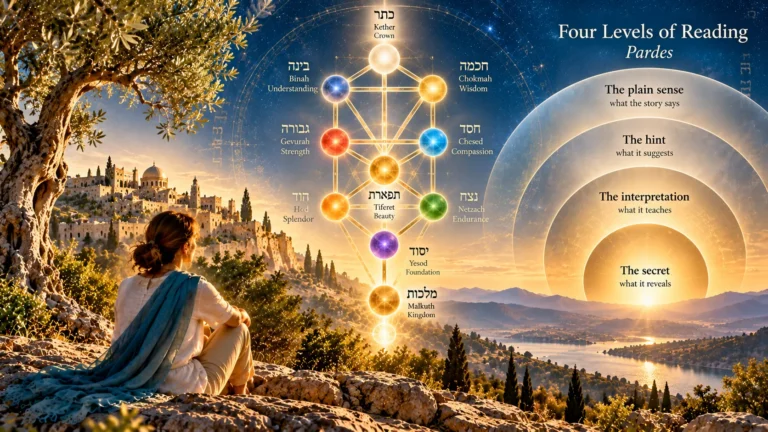
Renaissance thinkers added a bold idea: an ancient wisdom, or prisca theologia, passed from Hermes and Moses to Plato, was thought to run beneath all religions. Historians have shown that this chain was largely imagined. In 1614, the scholar Isaac Casaubon dated the Hermetic texts to the Christian era, not to the time of Moses. Yet the intuition of a shared depth beneath different symbolic languages remains alive. Kabbalistic psychology, for example, reads the Tree of Life as a map of the psyche rather than as a revealed account of the cosmos.
What does modern research say about esoteric thought?
For a long time, universities ignored esotericism or dismissed it as superstition. This began to change in 1964, when historian Frances Yates argued that Hermetic ideas had deeply shaped Renaissance culture, a thesis still debated. In Paris, Antoine Faivre took over a chair devoted to the history of esoteric currents in 1979; in 1999, the University of Amsterdam opened a centre for the field. Wouter Hanegraaff (2012) describes esotericism as the “rejected knowledge” of Western culture. These are historical interpretations, not experimental results.
On the psychological side, anthropologist Tanya Luhrmann (1989) observed members of modern magical groups in England gradually learning to interpret events through their group’s symbols, a process she called “interpretive drift”. Such research shows how symbolic systems shape perception; it says nothing about whether they are true. Transpersonal psychology explores this territory from the side of consciousness.
In a nutshell
Esoteric thought is a family of Western traditions, born in late antique Alexandria, that seek knowledge through symbols, correspondences and inner experience. From Hermeticism to alchemy, Kabbalah and tarot, its history shows one conviction taking many forms: to understand the world, we must also transform the one who looks.
Practice: Tracing an Idea (10 minutes)
Choose one belief that guides your life, such as “everything happens for a reason” or “we are here to grow”. Write for two or three minutes on each step:
- Origin. Where did I first meet this idea: a person, a book, a tradition?
- Register. Is it a symbol, a tradition, a hypothesis or a tested fact?
- Experience. What in my own life has confirmed it, and what has questioned it?
Then ask yourself: which of my beliefs have I simply received, and which have I truly made my own? This is a reflective exercise, not therapy.
Quote
“Know thyself.” — Inscription at the Temple of Apollo at Delphi, cited by Plato in the Charmides
Sources
- Copenhaver, Brian P. Hermetica: The Greek Corpus Hermeticum and the Latin Asclepius. Cambridge University Press, 1992.
- Faivre, Antoine. *Western Esotericism: A Concise History.* State University of New York Press, 2010.
- Hanegraaff, Wouter J. Esotericism and the Academy: Rejected Knowledge in Western Culture. Cambridge University Press, 2012.
- Luhrmann, Tanya M. Persuasions of the Witch’s Craft: Ritual Magic in Contemporary England. Harvard University Press, 1989.
- Yates, Frances A. Giordano Bruno and the Hermetic Tradition. University of Chicago Press, 1964.
Go deeper
- The Awakening Journal — a free reflective workbook to deepen your spiritual intelligence.
Related articles
- What Is Alchemy? (Wisdom & Spirituality)
- What Is Tarot? (Wisdom & Spirituality)
- What Is the Psychology of Religion? (Consciousness & Psychology)