What Is Astrology?
Astrology is an ancient symbolic language that reads the sky as a mirror of human life. But where does it come from? Do the planets really influence us, or do they simply speak to us? And what can a birth chart reveal about the turning points of a life?
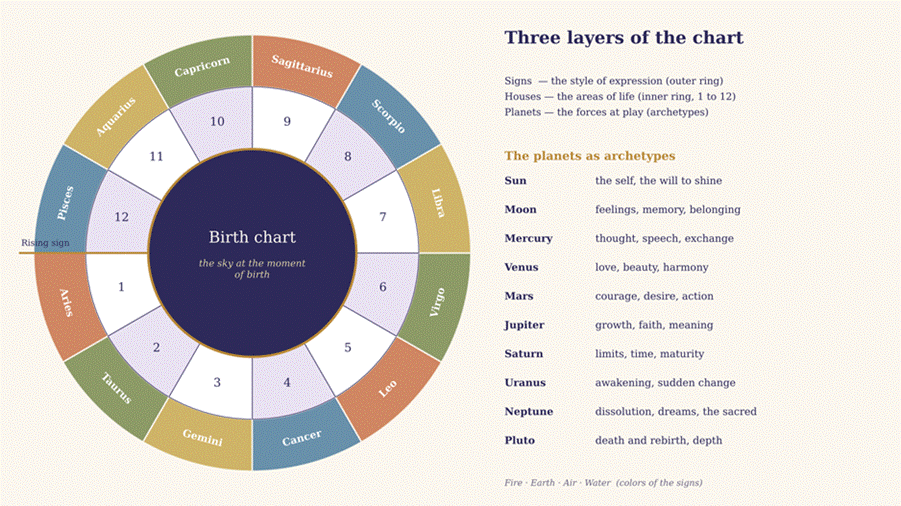
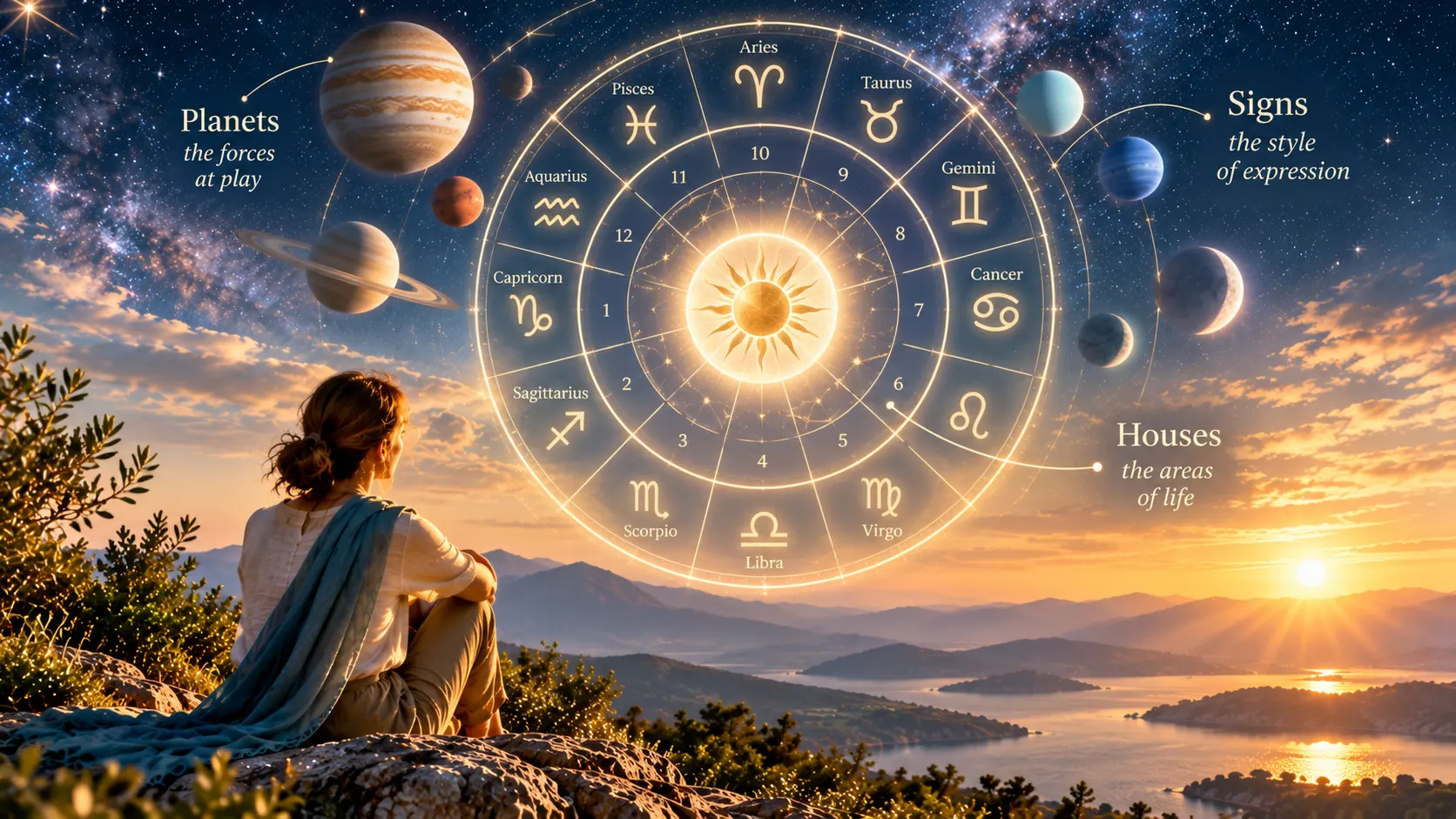
Symbolically, the birth chart is a mandala: the signs give the style, the houses the areas of life, and the planets the forces at play.
Astrology belongs to the great esoteric traditions of the West, alongside alchemy, tarot and Kabbalah. Like them, it rests on a founding intuition of Hermeticism: “as above, so below.” The sky and the Earth are seen as two expressions of one single order.
For many rational minds, astrology is a superstition, and daily horoscopes do little to change that view. Yet for more than two thousand years, it has served as a map for knowing oneself and understanding one’s time. Modern psychology, from Carl Jung to transpersonal psychology, has taken a fresh interest in it: not as a way to predict the future, but as a language of the psyche.
Astrology thus offers two things at once: a mirror for self-knowledge and a calendar of life’s great passages. Let us look at astrology from five angles.
Where does astrology come from?
Astrology was born in Mesopotamia. From the second millennium BCE, Babylonian priests recorded the movements of the planets as omens for the king and the kingdom. The oldest known personal horoscope, written on a clay tablet, dates from 410 BCE.
In Hellenistic Egypt, these observations met Greek geometry and philosophy. Horoscopic astrology was born there, with its twelve signs, its houses and its rising sign. In the second century CE, Claudius Ptolemy summed up this knowledge in the Tetrabiblos (“Four Books”), the reference text for more than a thousand years.
Astrology then passed through the Arabic world, where scholars such as Abu Ma’shar refined it, before returning to Europe. During the Renaissance, Marsilio Ficino made it a medicine of the soul, and Johannes Kepler still cast horoscopes while he was discovering the laws of planetary motion. In the twentieth century, Dane Rudhyar, and later Richard Tarnas, turned it toward psychology.
What do the planets and signs symbolize?
Symbolically, each planet embodies an archetype: a universal pattern of human experience, in the sense Carl Jung gave the word. The Sun stands for the self and its will to shine, the Moon for feelings and memory, Mercury for thought and exchange, Venus for love and beauty, Mars for courage and desire. Jupiter expands; Saturn sets limits and teaches time. The slow outer planets, Uranus, Neptune and Pluto, speak of awakening, dissolution and deep transformation.
The twelve signs describe the style in which each archetype expresses itself, and the twelve houses the area of life where it acts: work, home, relationships, vocation. Take Mars in Libra. The warrior’s energy, placed in the sign of balance, may show itself as a fight for justice rather than open conflict. Read in this way, the birth chart becomes a symbolic portrait of the psyche.
What does astrology teach about life’s turning points?
In the astrological tradition, planetary cycles mark the seasons of a life. The best known is the Saturn return. Saturn takes about twenty-nine and a half years to travel around the zodiac and come back to its position at birth, around the ages of 29, 59 and 88.
Astrologers describe this period as a time of reckoning. What was borrowed from others (choices, roles, expectations) is put to the test; what is truly one’s own takes root.
Take a woman of 29. Saturn is returning to the place it held in her birth chart, in the tenth house, the house of vocation. For an astrologer, this transit raises one question: is the work she does truly hers, or the one others chose for her? The chart does not decide for her. It names the moment and shows where the test lies.
What is the deeper meaning of “as above, so below”?
In the Hermetic tradition, the human being is a microcosm, a small world that reflects the great world, the macrocosm. The birth chart is then a picture of the sky at the moment of birth, and also a picture of the soul arriving at that moment.
A medieval maxim sums up the spirit of this reading: astra inclinant, non necessitant, “the stars incline, they do not compel.” The chart describes potentials and tensions, not a fate. Freedom lies in the way each person lives them.
Some traditions go further. In kabbalistic astrology, inspired by the Sefer Yetzirah (“Book of Formation”), the planets and signs are linked to the letters of the Hebrew alphabet and to the paths of the Tree of Life. Reading the chart becomes a way of understanding one’s task in this life, which is what spiritual intelligence seeks to awaken.
What does modern research say about astrology?
Research does not support the idea that planets act on us through a physical force. In a double-blind test published in Nature (Carlson, 1985), astrologers could not match birth charts to personality profiles better than chance. Psychological astrology has largely drawn the lesson: it sets prediction aside and reads the chart as a symbolic language.
Other works echo this symbolic reading without confirming it. Jung’s concept of synchronicity (1952) describes meaningful coincidences with no causal link; this is a scholarly interpretation, not an experimental result. Richard Tarnas (2006) traced correspondences between planetary cycles and turning points in cultural history, a thesis that remains debated. Finally, some thinkers, such as the physicist David Bohm, Ervin Laszlo, Rupert Sheldrake and Bernardo Kastrup, suggest that mind and cosmos share one underlying order. These are philosophical hypotheses, not established science, but they open a frame in which consciousness and the sky can be read together.
✦
In a nutshell
Astrology is a symbolic language, born in Mesopotamia and shaped by Hermetic thought, that belongs to the great esoteric traditions of the West. It reads the sky as a mirror of the psyche: the planets as archetypes, their cycles as the seasons of a life. It does not predict; it helps us understand.
Practice: The Planet of the Moment (10 minutes)
Sit somewhere quiet with a notebook. You do not need your birth chart.
- Read the list of planetary archetypes in the image above, from the Sun to Pluto.
- Ask yourself which of these forces is most at work in your life right now. Choose one, without thinking too long.
- Write for five minutes about how it shows up: in your days, your relationships, your body, your dreams.
- Then ask what this archetype is asking of you: to grow, to set limits, to let go, to begin?
Close by completing this sentence: “In this season of my life, I am learning…” This is a reflective exercise, not therapy.
Quote
“Whatever is born or done at this particular moment of time has the qualities of this moment of time.” — C. G. Jung, In Memory of Richard Wilhelm (1930)
Sources
- Bohm, David, Wholeness and the Implicate Order, Routledge, 1980.
- Campion, Nicholas, A History of Western Astrology, 2 vols., Continuum, 2008–2009.
- Carlson, Shawn, “A double-blind test of astrology,” Nature, 318, 1985.
- Jung, C. G., Synchronicity: An Acausal Connecting Principle, Princeton University Press, 2010 (first published 1952).
- Tarnas, Richard, Cosmos and Psyche: Intimations of a New World View, Viking, 2006.
Go deeper
The Awakening Journal — a free reflective workbook to deepen your spiritual intelligence.
Related articles
- What Is Tarot? (Wisdom & Spirituality)
- What Is Alchemy? (Wisdom & Spirituality)
- What Is Transpersonal Psychology? (Consciousness & Psychology)