What Is Shamanism?
Shamanism is often called humanity’s oldest spiritual practice: a way of travelling, through trance, to the hidden side of the world and bringing back healing and knowledge. Where does it come from? Why did Carlos Castaneda and Michael Harner make it so popular in the West? And what can it still teach us today?
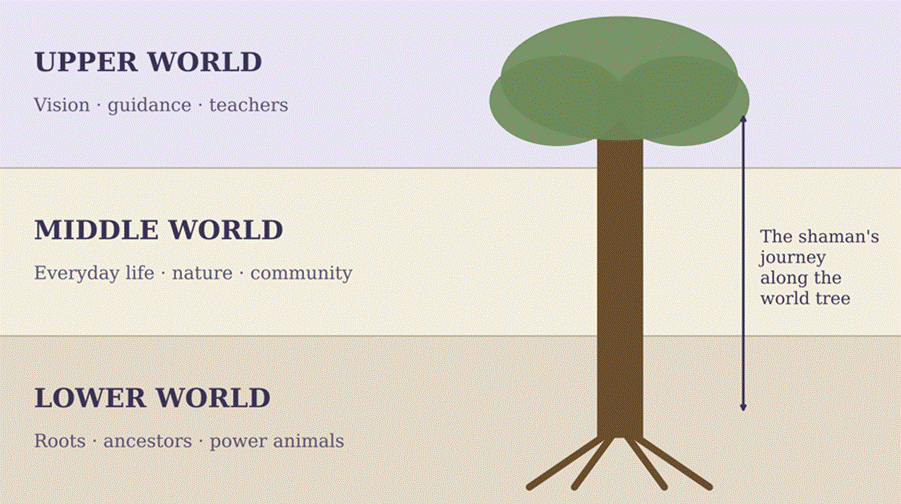
Symbolically, the world tree joins three worlds: below, the roots and the ancestors; in the middle, everyday life; above, vision and guidance.
Shamanism is one of the oldest spiritual practices known, and it stands with magic and the great myths among the deep roots of esoteric thought. The word comes from the Evenki people of Siberia, for whom the šaman is “the one who knows”: the person who enters trance to journey on behalf of the community.
Shamanism is not a single religion with a founder or a sacred book. It is a family of techniques found, with striking similarities, in Siberia, the Americas, the Arctic, Asia and Africa: the drum, the song, the journey, the dialogue with the spirits of nature and of the ancestors.
Why does it matter today? Because shamanism asks a question that modern life tends to forget: how do we stay in relationship with nature, with those who came before us and with the hidden parts of ourselves? It speaks to both halves of our motto: know yourself, understand the world. Let us look at shamanism from five angles.
Where does shamanism come from?
European travellers described Siberian shamans from the seventeenth century onwards, usually with suspicion. In 1951, the historian of religions Mircea Eliade gave the subject its classic study, defining the shaman as a specialist of ecstasy: someone whose soul is believed to leave the body and travel to the upper and lower worlds.
Two Americans then brought shamanism to a wide public. In 1968, Carlos Castaneda published The Teachings of Don Juan, presented as his apprenticeship with a Yaqui sorcerer in Mexico; it sold millions of copies. In 1976, however, Richard de Mille showed that the books were largely invented, and most scholars now read them as literary fiction. Michael Harner, an anthropologist who had lived with the Shuar and Conibo peoples of the Amazon, took another route. In The Way of the Shaman (1980), he described “core shamanism”, the methods he found common to many cultures, and founded the Foundation for Shamanic Studies. His approach has since influenced transpersonal psychology.
What does the shaman’s journey symbolize?
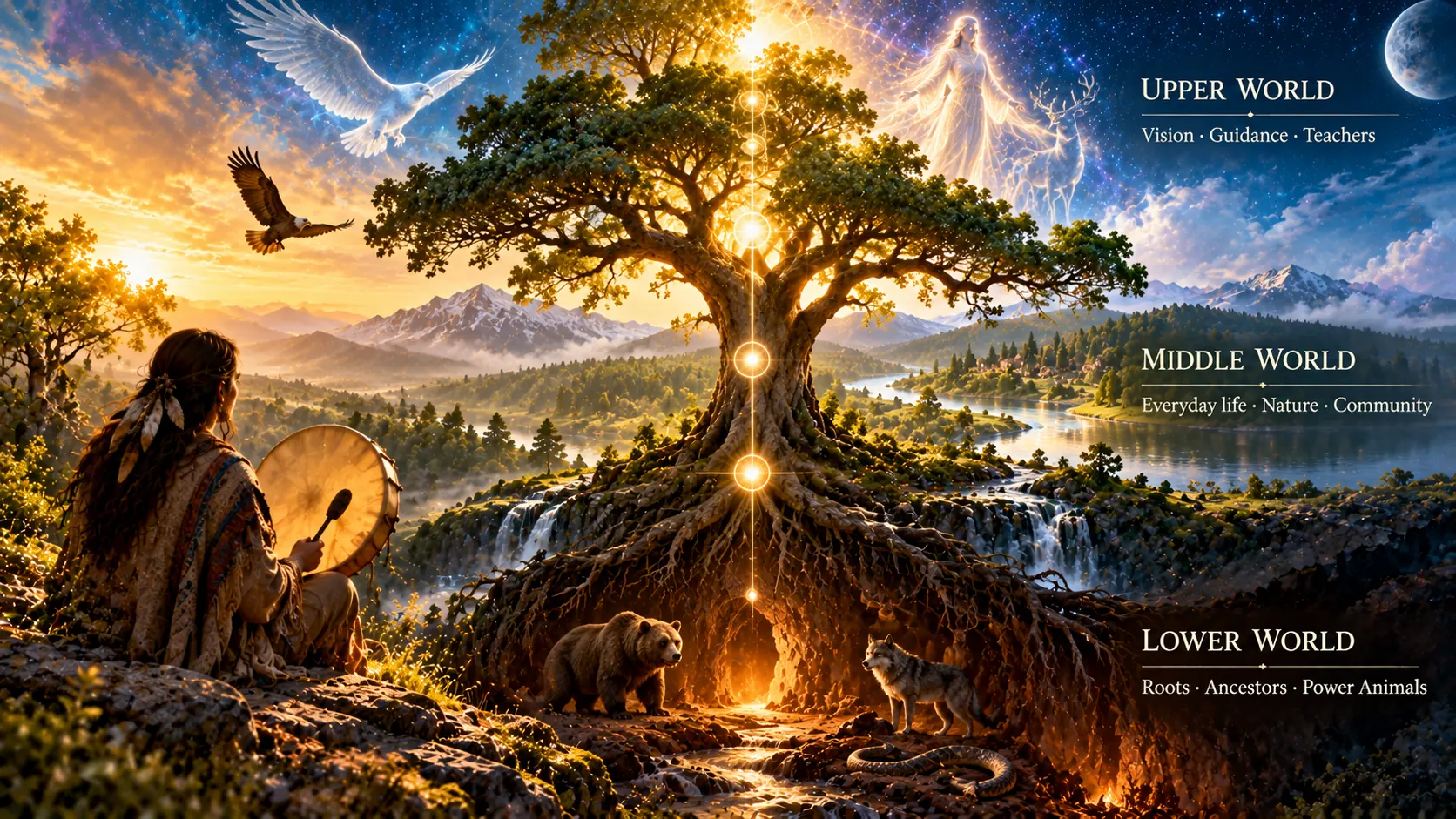
Symbolically, the shamanic universe has three levels, joined by a central axis: a world tree, a mountain or a pillar. The lower world holds the roots, the ancestors and the animal powers; the middle world is ordinary life; the upper world holds vision and guidance. The shaman climbs or descends this axis, a motif that echoes the Tree of Life of Kabbalah.
Other symbols recur everywhere. In Siberian traditions, the drum is called the shaman’s horse: it carries the journey. The power animal stands for a quality one needs, such as the endurance of the bear or the clear sight of the eagle. And initiation is often told as a dismemberment followed by rebirth, a theme that alchemy also knows. Symbolically, the old self is taken apart so that a wiser one can be put back together.
What does shamanism teach about life’s crises?
In shamanic traditions, the vocation often begins with a crisis: an illness, a loss or a breakdown that the community reads as a call. Eliade spoke of an “initiatory sickness”. The future shaman is not spared suffering; he or she learns to pass through it and to bring something back for others.
This offers a useful lens for anyone facing a major change. Take a woman who moves abroad after retirement. For months she feels lost: her language, her role and her friends are far away. Read through the shamanic lens, this is a journey into an unknown world. Instead of only waiting for it to end, she asks what this world is teaching her: which strengths she had forgotten, which new allies she might meet, what she will bring back.
In the shamanic tradition, healing also means restoring a balance between the person, the community and nature, not only repairing an individual.
What is “soul retrieval”?
At its deepest level, shamanism holds that a person can lose part of their soul through shock or grief, and that this part can be found and brought back. In the tradition, it is the shaman who journeys to retrieve it.
Read symbolically rather than literally, the idea is profound: after a painful event, something of our vitality, trust or joy can seem to stay behind, and wholeness means gathering these parts again. This reading is developed in shamanic psychology. Castaneda’s books, though fictional, popularised a related image: the “warrior” who takes responsibility for each choice and treats life as a path of knowledge. Harner, for his part, insisted on practice: the journey must be experienced, not only read about.
What does modern research say about shamanism?
Research in neuroscience has begun to explore what happens in the brain during shamanic trance. Michael Hove and colleagues scanned fifteen experienced practitioners while they listened to a steady drum. During trance, networks linked to inner-directed thought worked more closely together, while the processing of the drum sound itself decreased (Hove et al., 2016). The researchers suggest this may favour a long inner train of thought. This is a hypothesis about the brain, not proof that spirits exist or that journeys are real travels.
Anthropologists also debate whether “shamanism” is one universal phenomenon or a Western label placed on very different cultures, and some Indigenous peoples have criticised Harner’s core shamanism. These findings echo the shamanic intuition that rhythm opens an inner door; they do not confirm the doctrine.
In a nutshell
Shamanism is an ancient family of techniques, found on every continent, in which a specialist enters trance to journey between worlds on behalf of others. Studied by Eliade, popularised by Castaneda’s fiction and by Harner’s core shamanism, it offers a symbolic map for life’s crises: go down, meet what is there, and bring something back.
Practice: The Threshold Journey (10 minutes)
Sit comfortably in a quiet place, with a recording of a steady drum or simply a slow, regular breath.
- Intention. Name one question about a change you are going through.
- Journey. Close your eyes for five minutes and imagine a natural opening: a hollow tree, a cave, a spring. Do not force anything; simply notice what appears.
- Return. Count slowly from five to one, open your eyes, and write for three minutes about what you saw, felt or remembered.
Then ask yourself: what in this image could be an ally for the passage I am living? If you feel uneasy at any point, open your eyes and stop. This is a reflective exercise, not therapy.
Quote
“Shamanism = technique of ecstasy.” — Mircea Eliade, Shamanism: Archaic Techniques of Ecstasy
Sources
- Eliade, Mircea. Shamanism: Archaic Techniques of Ecstasy. 1951; Princeton University Press, 1964.
- Harner, Michael. The Way of the Shaman. Harper & Row, 1980; HarperOne, 1990.
- Castaneda, Carlos. The Teachings of Don Juan: A Yaqui Way of Knowledge. University of California Press, 1968.
- de Mille, Richard. Castaneda’s Journey: The Power and the Allegory. Capra Press, 1976.
- Hove, Michael J., et al. “Brain Network Reconfiguration and Perceptual Decoupling During an Absorptive State of Consciousness.” Cerebral Cortex 26, no. 7 (2016).
Go deeper
- The Awakening Journal — a free reflective workbook to deepen your spiritual intelligence.
Related articles
- What Are Myths and Tales For? (Wisdom & Spirituality)
- What Is Alchemy? (Wisdom & Spirituality)
- What Is Kabbalistic Psychology? (Consciousness & Psychology)
By Elizabeth Carrio, MSc in Consciousness and Transpersonal Psychology · Published Octobre 18, 2026 · Last updated Octobre 2026 · Disclaimer