What Is Kabbalah?
Kabbalah is the mystical tradition of Judaism: a way of reading the world, sacred texts and our own lives as having a visible surface and a hidden depth. Where does it come from? What do its symbols of light, trees and broken vessels mean? And what can it teach anyone who simply wants to know themselves better?
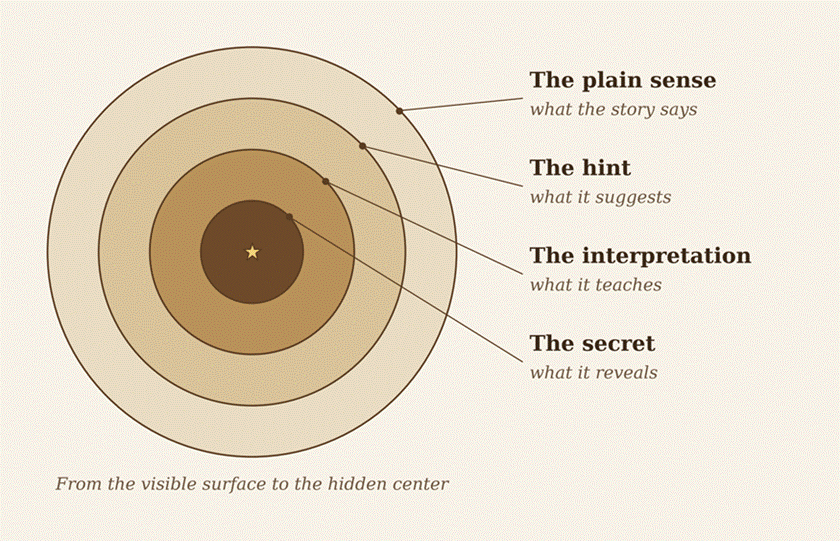
Symbolically, every text, every event and every life can be read on four levels, from the visible surface to the hidden center.
Kabbalah belongs to the great esoteric traditions of the West, alongside alchemy and gnosis. The word means “reception”: what is received, and handed on, from teacher to student. For centuries it was taught orally and to a few, which explains both its fascination and the many misunderstandings around it.
Its central intuition is simple to state. Everything has two faces: what is revealed and what is hidden. Some teachers describe this as looking with two eyes, a lower eye that sees the facts and an upper eye that perceives their meaning. Learning to use both is what the tradition calls discernment.
This is why Kabbalah still speaks to people who are neither Jewish nor religious. It offers a language for the moments when the surface of life cracks and we sense that something deeper is at work. Let us look at Kabbalah from five angles.
Where does Kabbalah come from?
Jewish mysticism is ancient, but Kabbalah as a distinct movement appears in Provence and Catalonia at the end of the twelfth century. Its central work, the Zohar (“Book of Splendor”), was written in Castile in the late thirteenth century. Tradition attributes it to a second-century sage, Shimon bar Yochai; the historian Gershom Scholem showed that it was most likely composed by Moses de León.
After the expulsion of the Jews from Spain in 1492, the tradition found a new center in Safed, a small town in Galilee. There, around 1570, Isaac Luria gave Kabbalah its most influential form: a vast story of creation, exile and repair, born among refugees who had lost everything.
From the Renaissance onward, Christian scholars such as Pico della Mirandola brought kabbalistic ideas into Latin. Through them, Kabbalah entered Western esotericism and, in the nineteenth century, the symbolic reading of the tarot.
What do the symbols of Kabbalah mean?
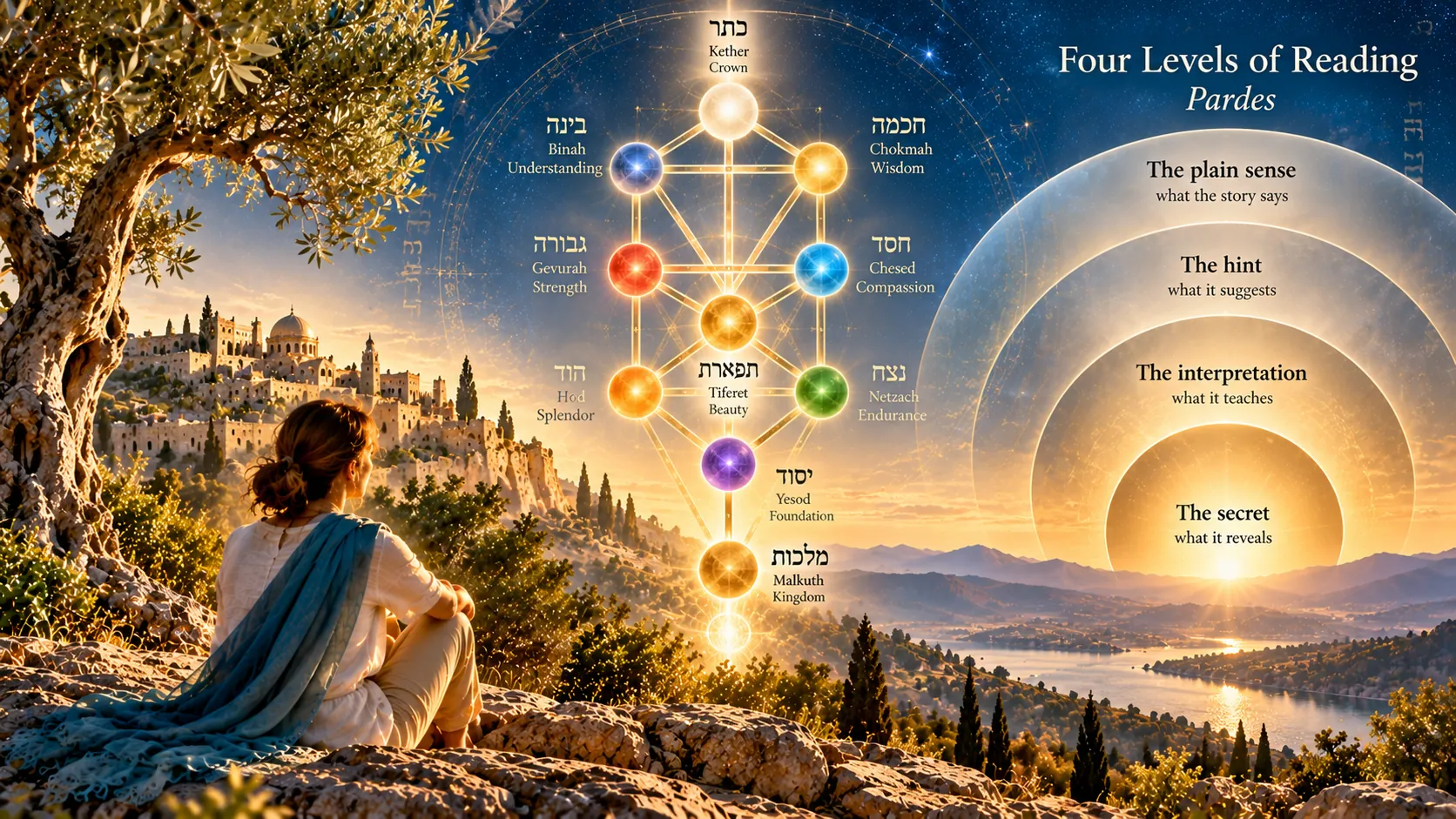
Symbolically, Kabbalah describes how the hidden becomes visible. At the source is Ein Sof, “without end”: the Infinite, beyond any image or name. Between this source and our world, light descends through ten qualities, the sefirot, traditionally drawn as a tree. Their reading as a map of the inner life is explored in our article on Kabbalistic psychology.
The tradition often speaks through pairs. In the reading of Isaac Luria’s school, Jacob’s two wives become two worlds: Leah, the hidden world, and Rachel, the revealed world. The human being, like Jacob, is bound to both.
A concrete example is Hanukkah, the festival of lights, when one more candle is lit each night for eight nights. Seven is the number of natural time, the days of the week; eight points beyond it. Symbolically, each new flame reveals one more facet of the soul.
What does Kabbalah teach about difficult times?
In the tradition of Isaac Luria, creation begins with a withdrawal: the Infinite steps back to make room for the world. Its light is then poured into vessels that cannot hold it. They shatter, and sparks of light fall, scattered and hidden in matter. The human task is tikkun, “repair”: finding those sparks and raising them.
Read as a teaching for life, this story changes the question we ask in a crisis. A breakdown is not necessarily a punishment; it may be a vessel that had become too small. Some teachers add that obstacles gather precisely on the link between our visible life and our deeper purpose, as if to cut it. Remembering what we live for keeps that link alive.
Consider a woman who retires and moves to another country. Her professional identity, her language and her network break at once. Instead of asking “why did I lose all this?”, she can ask “what spark is hidden in this break?”: a curiosity she had set aside, a freedom she had never allowed herself. Recognizing the break, finding the spark, then acting on it: this is repair in everyday life.
What is the hidden meaning of Kabbalah?
Kabbalah is first of all an art of reading. Medieval Jewish interpreters distinguished four levels of meaning, whose initials form the word pardes, “orchard”: the plain sense, the hint, the interpretation and the secret. According to the Zohar, the stories of the Torah are only its garment; whoever stops at the garment misses the body and the soul beneath.
The secret, then, is not hidden information reserved for a few. It is a way of seeing in which the upper and lower worlds are two faces of one reality. Because Hebrew letters are also numbers, a word or a name can be read as a pattern of qualities, an idea that later nourished kabbalistic astrology. At its deepest, Kabbalah asks each person to find the note of their own soul and to live in harmony with it: first, to know oneself.
What does modern research say about Kabbalah?
Kabbalah became a subject of academic research with Gershom Scholem, whose Major Trends in Jewish Mysticism (1941) traced its history from its origins to Hasidism. Moshe Idel (1988) later stressed its experiential side: meditation, letter combination and prayer aimed at changing states of consciousness. These are scholarly interpretations, not experimental results.
No scientific study confirms the doctrines of Kabbalah, and none could: they concern meaning, not measurable facts. Psychology does, however, study the experiences mystics describe. Research on self-transcendent experiences (Yaden and colleagues, 2017) has found that moments of reduced self-focus and increased connection are widespread, can be described precisely, and are often linked to lasting positive effects. Such findings echo the kabbalistic intuition of a hidden unity; they do not prove it.
✦
In a nutshell
Kabbalah is the mystical tradition of Judaism and one of the great esoteric traditions of the West. It reads the world, sacred texts and our lives on several levels, from the visible to the hidden, and invites each person to repair what is broken by finding the light hidden within it.
Practice: The Two Eyes (10 minutes)
Sit quietly with a notebook and, if you wish, light a candle.
- Lower eye. Choose a change you are living through. Describe it in three factual sentences, without judgment.
- Upper eye. Ask: what is this situation revealing about who I am becoming? Write down the first image that comes.
- The spark. Name one thing of value hidden in this situation: a strength, a desire, a freedom.
- Repair. Choose one small action, this week, that brings that spark into your daily life.
To close, ask yourself: what link between my visible life and my deeper purpose do I want to protect?
This is a reflective exercise, not therapy.
Quote
“Woe to the man who says that the Torah merely tells us tales in general and speaks of ordinary matters.” — Zohar III, 152a, translated by Louis Jacobs
Sources
- Fine, L., Physician of the Soul, Healer of the Cosmos: Isaac Luria and His Kabbalistic Fellowship, Stanford University Press, 2003.
- Idel, M., Kabbalah: New Perspectives, Yale University Press, 1988.
- Scholem, G., Major Trends in Jewish Mysticism, Schocken Books, 1941.
- Yaden, D. B., Haidt, J., Hood, R. W., Vago, D. R., and Newberg, A. B., “The Varieties of Self-Transcendent Experience”, Review of General Psychology, 21(2), 2017.
Go deeper
- The Awakening Journal — a free reflective workbook to deepen your spiritual intelligence.
Related articles
- What is Kabbalistic psychology? (Consciousness & Psychology)
- What Is Alchemy? (Wisdom & Spirituality)
- What Is Tarot? (Wisdom & Spirituality)