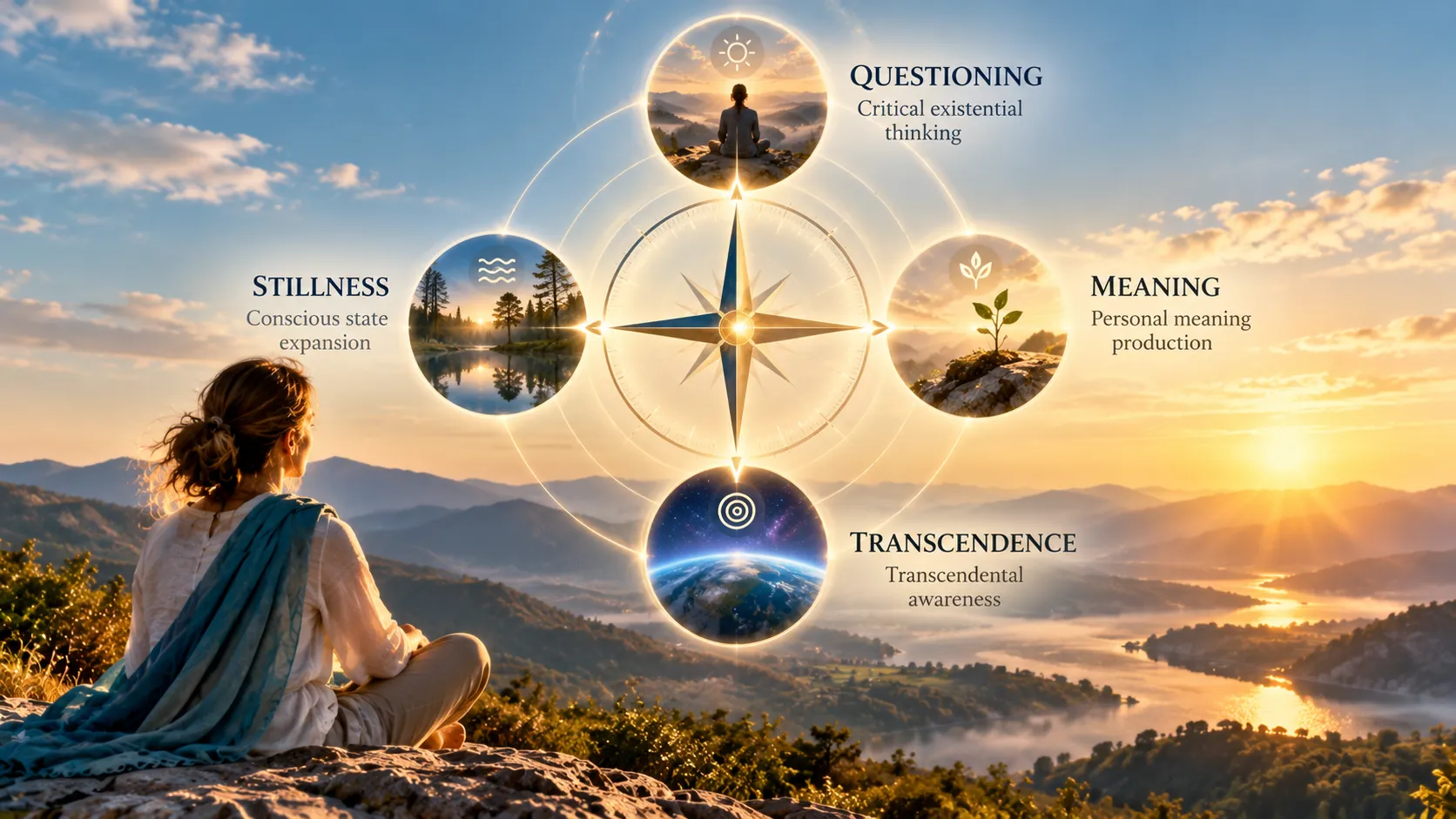
What Is Spiritual Intelligence?
Spiritual intelligence is the capacity to ask questions of meaning, to see beyond the immediate and to act from deeper values, especially when life stops making sense. Is it really a form of intelligence? Can it be measured? And how can it be developed in everyday life?
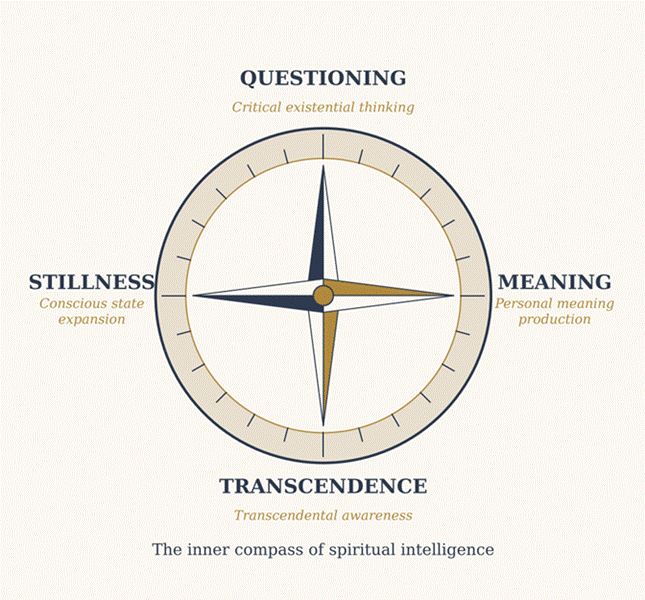
Symbolically, spiritual intelligence works like an inner compass: it does not draw the road, it keeps the direction.
Spiritual intelligence is a field of contemporary psychology, at the crossroads of the psychology of religion and transpersonal psychology. It describes a set of capacities rather than a belief: the ability to reflect on existence, to draw meaning from what happens, to sense a larger whole and to reach deeper states of awareness.
The notion matters because modern life tests it constantly. A career ends, a country changes, a loved one dies, and questions surface that neither reasoning nor emotional skills can settle: why this, what now, what truly matters? Spiritual intelligence is what we use, often without knowing it, to live with these questions and to act from our deepest values.
It also helps us understand the world, since entire cultures have trained the same capacities under other names. Let us look at spiritual intelligence from five angles.
Where does the idea of spiritual intelligence come from?
The idea grew out of a broader question: is intelligence one thing or many? In 1983, the psychologist Howard Gardner proposed that people have several intelligences, from the logical to the interpersonal. He later considered adding an existential intelligence: the capacity to ponder the great questions of life and death.
In 2000, Robert Emmons, a psychologist at the University of California, Davis, went further. In a special issue of the International Journal for the Psychology of Religion, he argued that spirituality itself meets the criteria of an intelligence, because it helps people solve real problems of living. Gardner disagreed in the same issue, and the debate has never been fully closed. That same year, Danah Zohar and Ian Marshall popularised the term “SQ”, a third quotient beside IQ and EQ. In 2008, the Canadian researcher David King proposed the model most widely used in research today.
What are the core capacities of spiritual intelligence?
In King’s model, spiritual intelligence rests on four capacities, each of which can be observed in ordinary life.
- Critical existential thinking: reflecting on death, meaning and the nature of reality without settling for ready-made answers. Example: asking “what is my work actually for?” after a promotion that brings no joy.
- Personal meaning production: drawing a purpose from what happens, including loss and failure.
- Transcendental awareness: perceiving a larger whole (nature, humanity, the sacred) to which one belongs.
- Conscious state expansion: entering deeper states of awareness at will, through prayer, meditation or contemplation.
Emmons adds an everyday dimension: the ability to treat ordinary moments, a shared meal or a walk, as sacred. Symbolically, these four capacities form an inner compass. They do not trace the road; they keep the direction.
What does spiritual intelligence reveal about times of crisis?
Spiritual intelligence becomes visible when ordinary resources run out. Elizabeth Carrio, who has devoted several books to the subject, proposes that many crises of meaning are not only breakdowns but also the beginning of an awakening, and that confusing the two leads people to silence what is trying to emerge. This is an author’s thesis, offered as a way of reading experience.
She identifies four conditions that allow spiritual intelligence to awaken: silence, which makes the inner voice audible; embodied awareness, because the body often knows before the mind; coherence, when thoughts, emotions, body and values move together; and the acceptance of paradox, the ability to hold two truths at once.
Consider Claire, 58, made redundant after thirty years in the same company. Her first questions are practical. Then others arise: who am I without this title, and what do I want the coming years to be for? Spiritual intelligence does not answer for her. It allows her to stay with the question long enough for a new direction to appear, perhaps passing on what she has learned.
How do the wisdom traditions train spiritual intelligence?
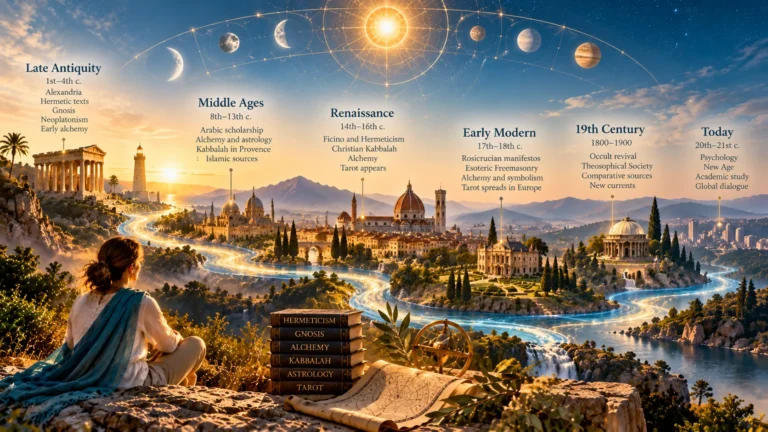
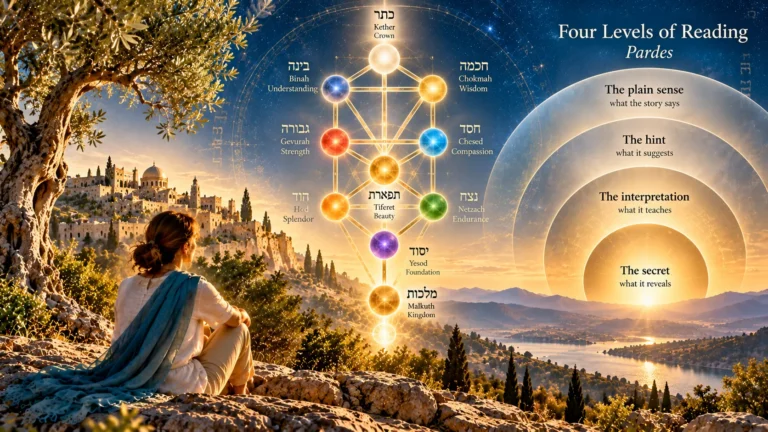
Long before psychologists named it, the wisdom traditions cultivated these same capacities. In the Stoic tradition, the evening review of one’s day trained reflection on one’s actions. In the Christian tradition, Ignatius of Loyola taught the discernment of spirits: noticing which inner movements lead toward life and which lead away from it. Contemplative practices in Buddhism, Sufism and Jewish mysticism developed deeper states of awareness.
Alchemy offers perhaps the richest image. Symbolically, the slow work of turning lead into gold describes the transformation of raw experience into wisdom. From this angle, spiritual intelligence is less a talent one possesses than an inner work one undertakes. This is a scholarly interpretation, not an experimental result.
What does modern research say about spiritual intelligence?
Research on spiritual intelligence (King and DeCicco, 2009) produced a 24-item questionnaire, the SISRI-24, which shows good reliability and has been translated into several languages. Studies have found that higher scores tend to go with higher emotional intelligence (King, Mara and DeCicco, 2012). Results on well-being are more mixed: a study of university students in Hong Kong found no link with life satisfaction (Chan and Siu, 2016).
The concept itself remains debated. Some researchers ask whether spirituality is an intelligence at all, or rather a broader dimension of personality (Watts and Dorobantu, 2023), and no area of the brain appears to be devoted to it alone. These findings echo what the traditions describe; they do not prove any spiritual doctrine.
✦
In a nutshell
Spiritual intelligence is the set of capacities that allow us to question existence, draw meaning from what happens, sense a larger whole and reach deeper states of awareness. A field of contemporary psychology, it gives a modern name to what the wisdom traditions have always trained.
Practice: The Four Voices (7 minutes)
Sit comfortably, bring to mind a situation or decision that occupies you, and give each part of yourself a turn to speak. Write one sentence for each.
- Mind: what do you think about this situation?
- Heart: what do you feel? Name the emotion without judging it.
- Body: where do you feel this situation in your body? Tension, heaviness, lightness?
- Soul: what matters most here, beyond the outcome?
Read the four sentences together. Where do they agree, and where do they pull apart? Which voice needs to be heard today? This is a reflective exercise, not therapy.
“If a man knows the wherefore of his existence, then the manner of it can take care of itself.” — Friedrich Nietzsche, Twilight of the Idols (1888)
Sources
- Carrio, Elizabeth, Awakening the Spiritual Mind, O-Books, 2026.
- Emmons, Robert A., “Is Spirituality an Intelligence?”, International Journal for the Psychology of Religion, 10(1), 2000.
- King, David B. and DeCicco, Teresa L., “A Viable Model and Self-Report Measure of Spiritual Intelligence”, International Journal of Transpersonal Studies, 28(1), 2009.
- Watts, Fraser and Dorobantu, Marius, “Is There ‘Spiritual Intelligence’?”, Religions, 14(2), 2023.
- Zohar, Danah and Marshall, Ian, SQ: Spiritual Intelligence, the Ultimate Intelligence, Bloomsbury, 2000.
Go deeper
- The Awakening Journal — a free reflective workbook to deepen your spiritual intelligence.
Related articles
- What Is the Psychology of Religion? (Consciousness & Psychology)
- What Are Personal Values? (Consciousness & Psychology)
- What Is Alchemy? (Wisdom & Spirituality)
By Elizabeth Carrio, MSc in Consciousness and Transpersonal Psychology · Published October 18,2026 · Last updated October 2026 · Disclaimer