
What Is Shamanic Psychology?
Shamanic psychology looks at the human mind through the eyes of the world’s oldest healing traditions. What can a shaman’s drum teach a modern therapist? What does it mean to “lose part of your soul”? And what actually happens in the brain during a shamanic journey?
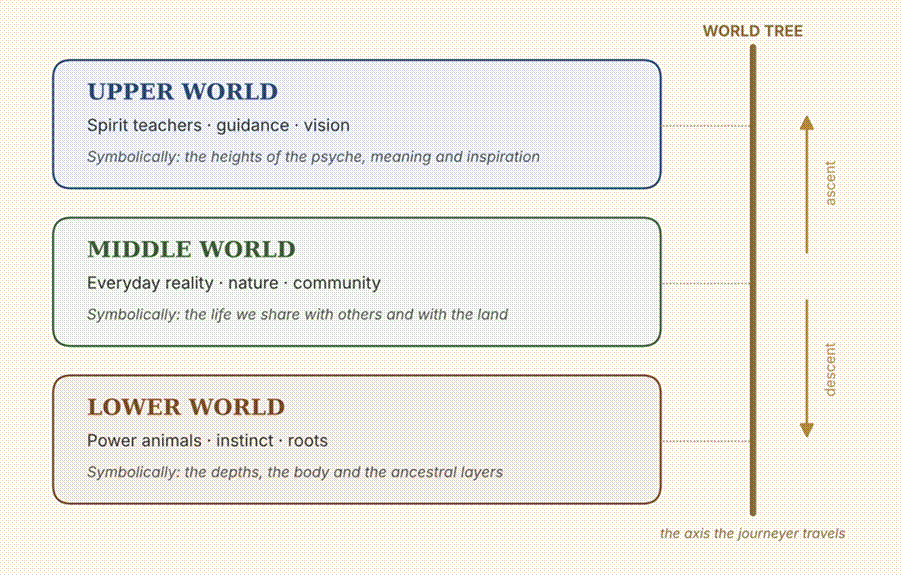
Symbolically, the three worlds map the heights, the everyday life and the depths of the psyche.
Shamanic psychology is one of the applications of shamanism, a family of traditions whose practitioners deliberately enter altered states of consciousness to journey to other worlds on behalf of their community. It takes the shaman’s map of the soul and asks what it reveals about the human mind.
Long before the first clinic opened, shamans were the people a community turned to when someone lost their health, their bearings or their will to live. The psychiatrist Jerome Frank saw in them the forerunners of today’s psychotherapists. Their questions are still ours: what makes us whole, and what can we do when part of us seems to have gone missing?
Shamanic psychology does not ask anyone to adopt a belief. It invites us to take seriously an experience reported across cultures, and to explore it with both respect and critical thinking. Let us look at shamanic psychology from five angles.
Where does shamanic psychology come from?
The word shaman comes from šaman, a term used by the Evenki people of Siberia for a healer who travels in spirit. In 1951, the historian of religions Mircea Eliade described shamanism as an “archaic technique of ecstasy” found on every continent. In 1980, the anthropologist Michael Harner distilled what he called “core shamanism” into a method Westerners could learn, centered on the journey to the sound of a drum.
Psychologists then took up the subject. The psychiatrist Roger Walsh defined shamanism as a family of traditions built on voluntary journeys in altered states, undertaken to serve the community. Stanley Krippner questioned the old idea that shamans were mentally ill. And the transpersonal psychologist Steven Schmitz, who taught the subject at the Alef Trust, prefers the term “shamanistic psychology”: not the psychology of shamans themselves, but a psychology shaped by the shamanic way of seeing.
What are the key ideas of shamanic psychology?
In the shamanic tradition, three principles hold everything together: all beings are connected in a web of life; everything is alive and has its own form of awareness; and helping spirits can guide and support us. The journey takes the practitioner, usually lying down to a steady drumbeat, into an Upper, Middle or Lower World, where they meet allies such as a power animal or a spirit teacher.
The most psychological notion is soul loss. In the tradition, a shock can cause part of the soul to flee, and the shaman’s task is to bring it back through soul retrieval. People often say, “I haven’t been myself since the accident.” As a symbol, soul loss describes what psychologists call dissociation: a part of our experience that has been split off to help us survive.
What does shamanic psychology reveal about modern life?
The word psychology literally means “study of the soul”. Shamanic psychology suggests that much of our modern suffering comes from disconnection: from nature, from community, from our ancestors and from our own soul. In 1992, James Hillman summed up the doubt in a book title: We’ve Had a Hundred Years of Psychotherapy—and the World’s Getting Worse.
Consider a woman who emigrates at sixty. She settles in well, yet feels oddly absent, as if part of her had stayed behind. In shamanic terms, a piece of her soul remained in the old country; in psychological terms, a transition has not been completed. The shamanic answer is not a diagnosis but a ritual of return: honoring what was left behind, and building new bonds with the land, the people and the ancestors.
Traditional rites of passage, such as the vision quest of some Native American nations, served this purpose. A young person spent several days alone in nature to receive a vision of their place in the world. Today, the same need for meaning lies at the heart of existential psychology.
How does shamanic psychology connect with the wisdom traditions?
In many shamanic traditions, the shaman’s calling begins with an initiatory crisis, often experienced as being taken apart and then put back together. The same pattern of dissolution and rebirth runs through alchemy, where the work begins with the blackening, and through the hero’s journey of myths and tales.
The World Tree that links the three worlds echoes the Tree of Life of Kabbalistic psychology: in both, the soul rises and descends along a vertical axis. Carl Jung wrote in a 1945 letter that “the approach to the numinous is the real therapy.” Read through Jung, the shaman becomes the first specialist of that approach. This is a scholarly interpretation, not an experimental result.
What does modern research say about shamanic states?
A review of field research on shamans (Krippner, 2002) found little support for the view that they are psychotic; many appear well adjusted and play a stabilizing role in their communities. This is a review of anthropological and psychological studies, not a clinical trial.
Research on the brain has begun to explore the journey itself. In a study of fifteen experienced practitioners listening to drumming (Hove et al., 2016), the shamanic trance was linked to stronger connections between regions involved in inward-directed thought and attention, and to weaker processing of the repetitive drum sound. The authors suggest this may support an extended stream of inner thought in which insight can occur. These findings echo the tradition’s description of an inner journey; they do not prove the existence of spirits.
✦
In a nutshell
Shamanic psychology is one of the applications of shamanism: it reads the shaman’s map of the soul (the journey, soul loss, the web of life) as a psychology of connection. It reminds us that inner healing often begins when we reconnect with nature, with others and with the parts of ourselves we left behind.
Practice: A Question for the Living World (10 minutes)
In the shamanic tradition, the living world answers those who ask; here, we use that idea as a mirror for reflection. Find a quiet spot outdoors, or sit by an open window, and put your phone away.
- Write down one open question about your life, starting with “What” or “How”, for example: “What do I need to understand about this change?”
- Close your eyes for one minute and breathe slowly, holding the question lightly.
- Open your eyes and let your attention wander for five minutes. Notice what draws you: a bird, a sound, the shape of a branch, a gust of wind.
- Write down what you noticed, then ask yourself: if this were an answer, what would it be saying to me?
What surprised you in that answer? This is a reflective exercise, not therapy.
Quote
“Our normal waking consciousness, rational consciousness as we call it, is but one special type of consciousness, whilst all about it, parted from it by the filmiest of screens, there lie potential forms of consciousness entirely different.” — William James, The Varieties of Religious Experience (1902)
Sources
- Eliade, M. Shamanism: Archaic Techniques of Ecstasy. Princeton University Press, 1964 (first French edition 1951).
- Harner, M. The Way of the Shaman. Harper & Row, 1980.
- Hove, M. J., et al. Brain Network Reconfiguration and Perceptual Decoupling During an Absorptive State of Consciousness. Cerebral Cortex, 26(7), 2016.
- Krippner, S. Conflicting Perspectives on Shamans and Shamanism: Points and Counterpoints. American Psychologist, 57(11), 2002.
- Walsh, R. The World of Shamanism: New Views of an Ancient Tradition. Llewellyn, 2007.
Go deeper
- The Awakening Journal — a free reflective workbook to deepen your spiritual intelligence.
Related articles
- What Is Alchemy? (Wisdom & Spirituality)
- What Is Kabbalistic Psychology? (Consciousness & Psychology)
- What Is Consciousness? (Consciousness & Psychology)
By Elizabeth Carrio, MSc in Consciousness and Transpersonal Psychology · Published December 8 · Disclaimer