What Is Neuroscience?
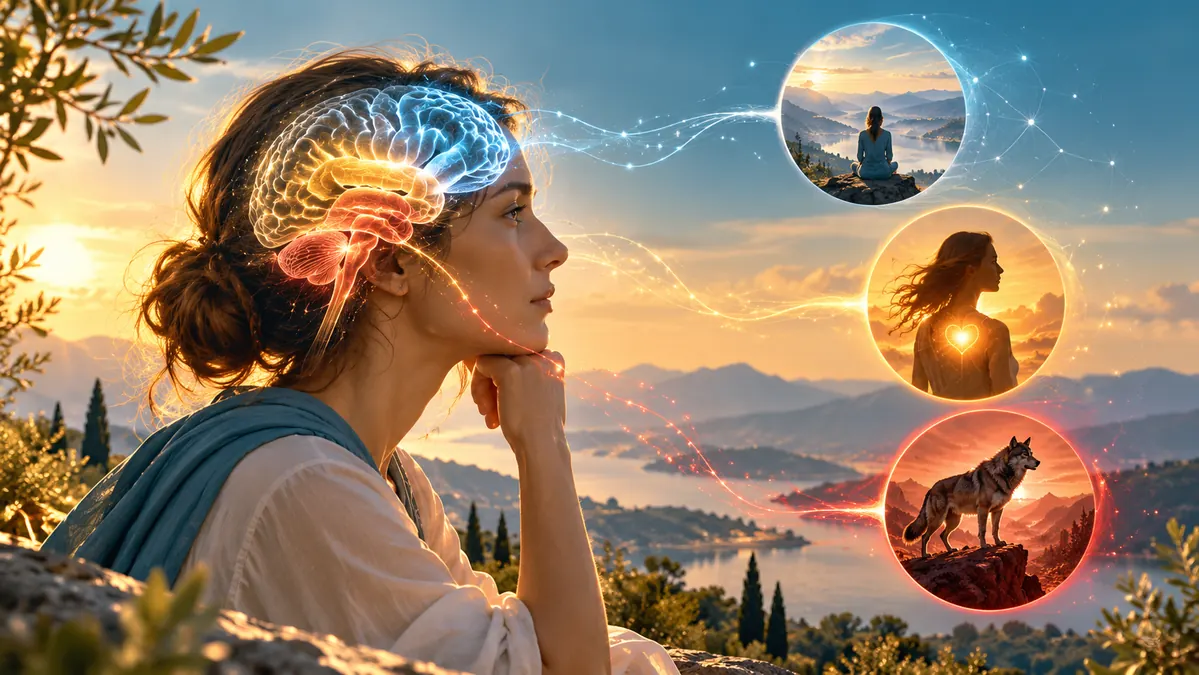
Neuroscience is the scientific study of the nervous system, and above all of the brain that shapes how we feel, decide and act. Why do we freeze when we should speak? Why does stress narrow our thinking? And can we really change the way our brain responds?
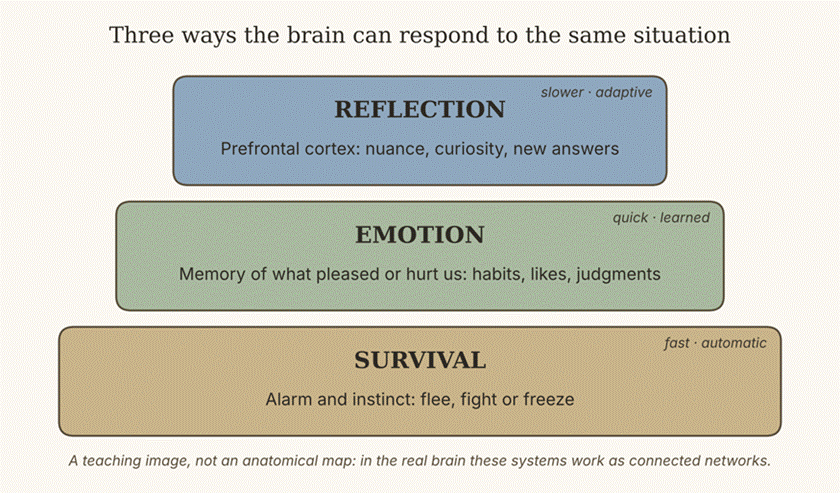
Symbolically, three voices answer every situation: survival, emotion and reflection.
Neuroscience is the most experimental field of the Consciousness & Psychology door: it studies, with measurements and images, the living organ behind our thoughts and emotions. It brings together biology, medicine, psychology and computer science around one question: how does a mass of cells produce a person, with memories, choices and consciousness?
Why does it matter outside the laboratory? Because much of what we call character, stress or lack of motivation depends on how our brain systems cooperate, or compete, when we face something new or difficult. Understanding these mechanisms helps us to know ourselves, to understand others, and to distinguish what we can change from what we can only manage.
Neuroscience does not replace the questions of philosophy or the insights of the wisdom traditions; it lights them from another side. Let us look at the brain from five angles.
Where does neuroscience come from?
People have wondered about the brain since antiquity, but modern neuroscience begins in the late nineteenth century. Using a silver stain, the Spanish scientist Santiago Ramón y Cajal showed that the nervous system is made of distinct cells, the neurons, which communicate across tiny gaps later called synapses. This discovery earned him the Nobel Prize in 1906, shared with Camillo Golgi.
A famous accident had already shown how closely brain and personality are linked. In 1848, the American railway foreman Phineas Gage survived an iron rod passing through the front of his skull; according to his physician, the reliable worker became impulsive and unpredictable. The word “neuroscience” only appeared in the 1960s, when researchers chose to unite anatomy, chemistry, physiology and psychology in a single field. Today, brain imaging lets us watch the living brain at work.
How does the brain process a situation?
A popular model, proposed by the physician Paul MacLean in the 1960s, describes three layers shaped by evolution: an ancient “survival brain” for instinct and alarm, an “emotional brain” that stores what pleased or hurt us, and the prefrontal cortex, which reasons, imagines and adapts to what is new. Science has since corrected this anatomy, as we will see, but the image still helps us recognize three kinds of response.
A key idea follows. What shapes our behavior is not only the situation, the content, but the state of mind that processes it, the container. Take a driver stuck in a traffic jam before an important meeting. One honks and shouts (survival). Another sulks because “this always happens to me” (emotional memory). A third calls ahead and uses the time to prepare (reflection). Same jam, three different brains in charge.
What does neuroscience teach about stress?
Stress is first an alarm, a fast reaction designed to protect us. When danger is perceived, the body prepares to flee, to fight or, if neither seems possible, to freeze. The French physician Henri Laborit called this third reaction the “inhibition of action” and linked it, when it lasts, to anxiety and illness.
Seen this way, stress is a signal: the situation exceeds the routines we have learned, and our more reactive systems have taken over. Consider Anne, 52, who is offered a position abroad. At first every thought says “too risky” or “too late.” When she lists what she actually knows, asks three people with different views and imagines several scenarios, the panic eases and real options appear. Nothing changed outside her; her state of mind did.
This is where neuroscience joins self-knowledge: the first step is to notice which part of us is answering.
How does neuroscience meet the wisdom traditions?
Long before brain imaging, traditions described the human being in layers. In the Kabbalah, the soul has several levels: nefesh (the vital soul, tied to the body), ruach (the spirit of emotions and character) and neshamah (the higher soul, open to understanding). Symbolically, this ladder echoes the three responses described above, from survival to reflection.
In the alchemical tradition, alchemy speaks of turning lead into gold, and contemplative practices teach us to observe our reactions before acting on them. In each case the aim is similar: to stop being driven by automatic reactions and to choose our response, a capacity at the heart of spiritual intelligence. Neuroscience does not confirm these teachings; it offers a different language for a very old intuition.
What does modern research say about the brain?
Research has nuanced the three-layer model. Comparative studies show that the brain did not evolve by stacking new layers on top of old ones, and that emotion and reason rely on networks that constantly work together (Cesario, Johnson and Eisthen, 2020). Antonio Damasio (1994) observed that patients whose brain damage cut emotion off from reasoning made poor decisions in daily life. The same caution applies to “left-brained” and “right-brained” personalities: the two hemispheres specialize in some tasks but always cooperate.
Other findings are robust. Acute stress weakens the prefrontal cortex while strengthening more reflexive responses (Arnsten, 2009). And the brain changes with experience: London taxi drivers, who memorize thousands of streets, show a larger posterior hippocampus, a region involved in spatial memory (Maguire et al., 2000). This capacity, called neuroplasticity, continues throughout life.
In a nutshell
Neuroscience is the scientific study of the nervous system. It shows that our behavior depends not only on situations but on the state of mind that processes them, and that the brain keeps changing throughout life. Observing how we react is the first step toward choosing how we respond
Practice: Who Is Answering? (7 minutes)
Recall a recent situation that made you tense, then observe it in four steps.
- Notice your body: is the reaction closer to fleeing, fighting or freezing?
- Name the old rule that is speaking (“I must…”, “It always…”).
- Look at the situation through three other pairs of eyes: a curious child, an expert, yourself in ten years.
- Write down one small action you could now consider.
What changed between the first step and the last? This is a reflective exercise, not therapy.
Quote
“Any man could, if he were so inclined, be the sculptor of his own brain.” — Santiago Ramón y Cajal, Advice for a Young Investigator
Sources
- Santiago Ramón y Cajal, Advice for a Young Investigator, MIT Press, 1999 (first published 1897).
- Antonio Damasio, Descartes’ Error: Emotion, Reason, and the Human Brain, Putnam, 1994.
- Joseph LeDoux, The Emotional Brain, Simon & Schuster, 1996.
- Joseph Cesario, David J. Johnson and Heather L. Eisthen, “Your Brain Is Not an Onion With a Tiny Reptile Inside”, Current Directions in Psychological Science, 2020.
- Amy F. T. Arnsten, “Stress Signalling Pathways That Impair Prefrontal Cortex Structure and Function”, Nature Reviews Neuroscience, 2009.
Go deeper
The Awakening Journal — a free reflective workbook to deepen your spiritual intelligence.
Related articles
- What Is Consciousness? (Consciousness & Psychology)
- What Is Kabbalistic Psychology? (Consciousness & Psychology)
- What Is Alchemy? (Wisdom & Spirituality)
By Elizabeth Carrio, MSc in Consciousness and Transpersonal Psychology · Published October 17, 2026 · Last updated October 17, 2026 · Disclaimer