
What Is Hermeticism?
Hermeticism is a way of knowing in which understanding the universe and understanding oneself are a single path. Who was Hermes Trismegistus? What does “as above, so below” really mean? And why do these ancient texts still speak to anyone going through a time of change?
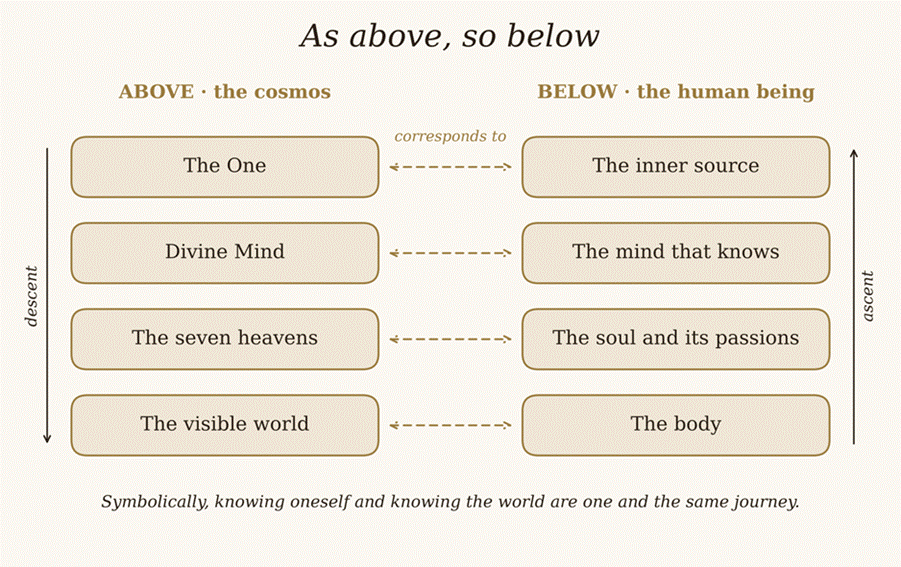
Symbolically, what lies above mirrors what lies below: to know oneself is to know the world.
Hermeticism belongs to the great esoteric traditions of the West, alongside alchemy, Gnosis and the Christian Kabbalah of the Renaissance. It takes its name from Hermes Trismegistus, the “thrice-great” sage to whom a body of texts on God, the cosmos and the human soul was attributed.
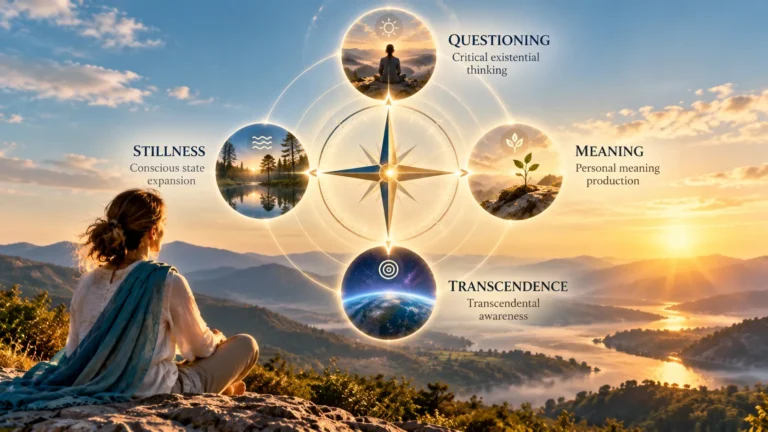
Why does it matter today? Because Hermeticism holds that the inner and the outer worlds answer each other. Its oldest advice is to know yourself in order to understand the world, and to look at the world in order to understand yourself.
This article belongs to the History of Esoteric Thought section of the Wisdom & Spirituality door; the psychological side of self-knowledge is explored in the Consciousness & Psychology door. Let us look at Hermeticism from five angles.
Where does Hermeticism come from?
The Hermetic texts were written in Greek in Roman Egypt, roughly between the first and third centuries CE. Their legendary author combines the Greek god Hermes, messenger between gods and humans, with Thoth, the Egyptian god of writing and wisdom. The main collection, the Corpus Hermeticum, gathers seventeen short treatises, often written as dialogues between a master and his pupil; a Latin text, the Asclepius, completes it. The famous Emerald Tablet came later and survives first in Arabic.
In the 1460s, Cosimo de’ Medici asked Marsilio Ficino to translate the Greek manuscript that had just reached Florence, even before finishing Plato. Printed in 1471, it fascinated the Renaissance, which believed Hermes to be as old as Moses. In 1614, the scholar Isaac Casaubon showed that the texts were far more recent. A copy of that first edition is kept today at the Embassy of the Free Mind in Amsterdam.
What do the Hermetic symbols suggest?
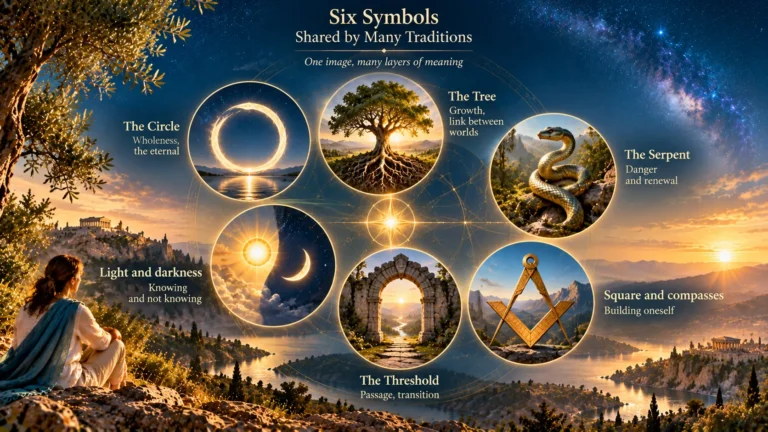
Symbolically, Hermes is the one who goes back and forth between worlds. He stands for the part of us that can link what we see to what we do not see. His staff with two intertwined serpents, the caduceus, suggests the meeting of opposites.
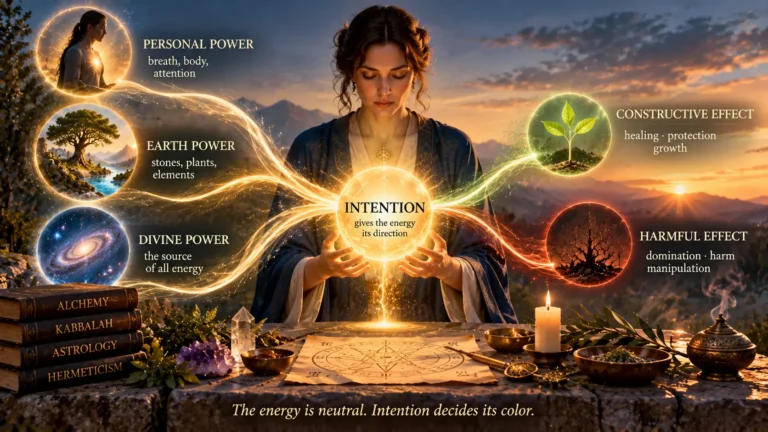
The best-known Hermetic image is the principle of correspondence: “as above, so below.” Symbolically, the human being is a small world that reflects the great one. The seven planetary spheres of the ancient sky find their echo in the soul, and the movements of the heavens mirror inner movements. This is why astrology, alchemy and magic all drew on Hermetic ideas: each reads one level of reality through another. On this principle, see also symbolism.
What does Hermeticism teach about times of change?
In the Hermetic tradition, the human being is not a stranger thrown into the world but a mind that has descended into it and can find its way back. In the thirteenth treatise, the pupil Tat asks his master how one can be “born again.” Hermes answers that rebirth does not come from outside: it happens when a person stops identifying only with the body and the senses and discovers a deeper awareness within.
Consider a woman who, at sixty, leaves her profession and her country. Her outer world is in pieces: no title, no familiar streets, no routine. A Hermetic reading invites her to ask what inner change this outer upheaval reflects. The question does not erase the difficulty, but it turns a loss into a passage, an idea that existential psychology also explores in its own terms.
What is the deeper meaning of Hermeticism?
At its deepest level, Hermeticism is a path toward gnosis, a knowledge that transforms the one who knows. The first treatise, the Poimandres, describes a vision in which Divine Mind reveals how the world came to be. The human soul descends through the seven spheres and receives a tendency from each; on the return journey, it gives each one back, until it is free.
Read as an inner path, this ascent describes a gradual letting go of compulsions, pride and fear. The aim is not to escape the world but to see it as it is: a living whole in which the divine is present. In the Hermetic tradition, to know God, one must become capable of embracing everything in thought.
What does modern research say about Hermeticism?
Historians have changed the way these texts are read. Wouter Hanegraaff (2022) argues that the Hermetica record spiritual practices carried out in very small groups, a teacher with a few pupils, aiming at transformative experiences rather than abstract philosophy. This is a scholarly interpretation, not an experimental result.
Psychology offers echoes, not proofs. Research on self-transcendent experiences (Yaden et al., 2017) describes states in which the sense of a separate self fades and the feeling of connection grows, and links some of them to well-being. Cognitive scientists also see analogy, the ability to recognize one pattern in another, as central to human thinking. These findings resonate with the Hermetic intuition of correspondence; they do not confirm its metaphysics. On how science approaches inner experience, see What Is Consciousness?.
In a nutshell
Hermeticism is one of the great esoteric traditions of the West. Born in Roman Egypt and revived by the Renaissance, it teaches that the human being mirrors the cosmos, and that knowing oneself and knowing the world are one and the same journey.
Practice: Above and Below
Take a notebook and a quiet moment, then follow these steps.
- Name one outer situation that is changing in your life right now: a move, a role ending, a relationship shifting.
- Write three words that describe it from the outside, as a witness would.
- Close your eyes for a minute. Ask yourself: what is changing inside me at the same time? Write three words.
- Place the two lists side by side and look for a correspondence: where does the outer picture echo the inner one?
Closing question: if this outer change were a mirror, what would it be showing you? This is a reflective exercise, not therapy.
Quote
“That which is below is like that which is above.” — The Emerald Tablet, translated by Isaac Newton
Sources
- Copenhaver, B. P., Hermetica: The Greek Corpus Hermeticum and the Latin Asclepius, Cambridge University Press, 1992.
- Fowden, G., The Egyptian Hermes: A Historical Approach to the Late Pagan Mind, Princeton University Press, 1986.
- Hanegraaff, W. J., Hermetic Spirituality and the Historical Imagination: Altered States of Knowledge in Late Antiquity, Cambridge University Press, 2022.
- Yates, F. A., Giordano Bruno and the Hermetic Tradition, Routledge and University of Chicago Press, 1964.
- Yaden, D. B., Haidt, J., Hood, R. W., Vago, D. R., and Newberg, A. B., “The Varieties of Self-Transcendent Experience”, Review of General Psychology, 21(2), 2017.
Go deeper
The Awakening Journal — a free reflective workbook to deepen your spiritual intelligence.
Our first free live talk takes place on Thursday, December 10, 2026.
Related articles
- What Is Alchemy? (Wisdom & Spirituality)
- What Is Gnosis? (Wisdom & Spirituality)
- What Is Consciousness? (Consciousness & Psychology)
By Elizabeth Carrio, MSc in Consciousness and Transpersonal Psychology · Published November 4th,2026· Disclaimer