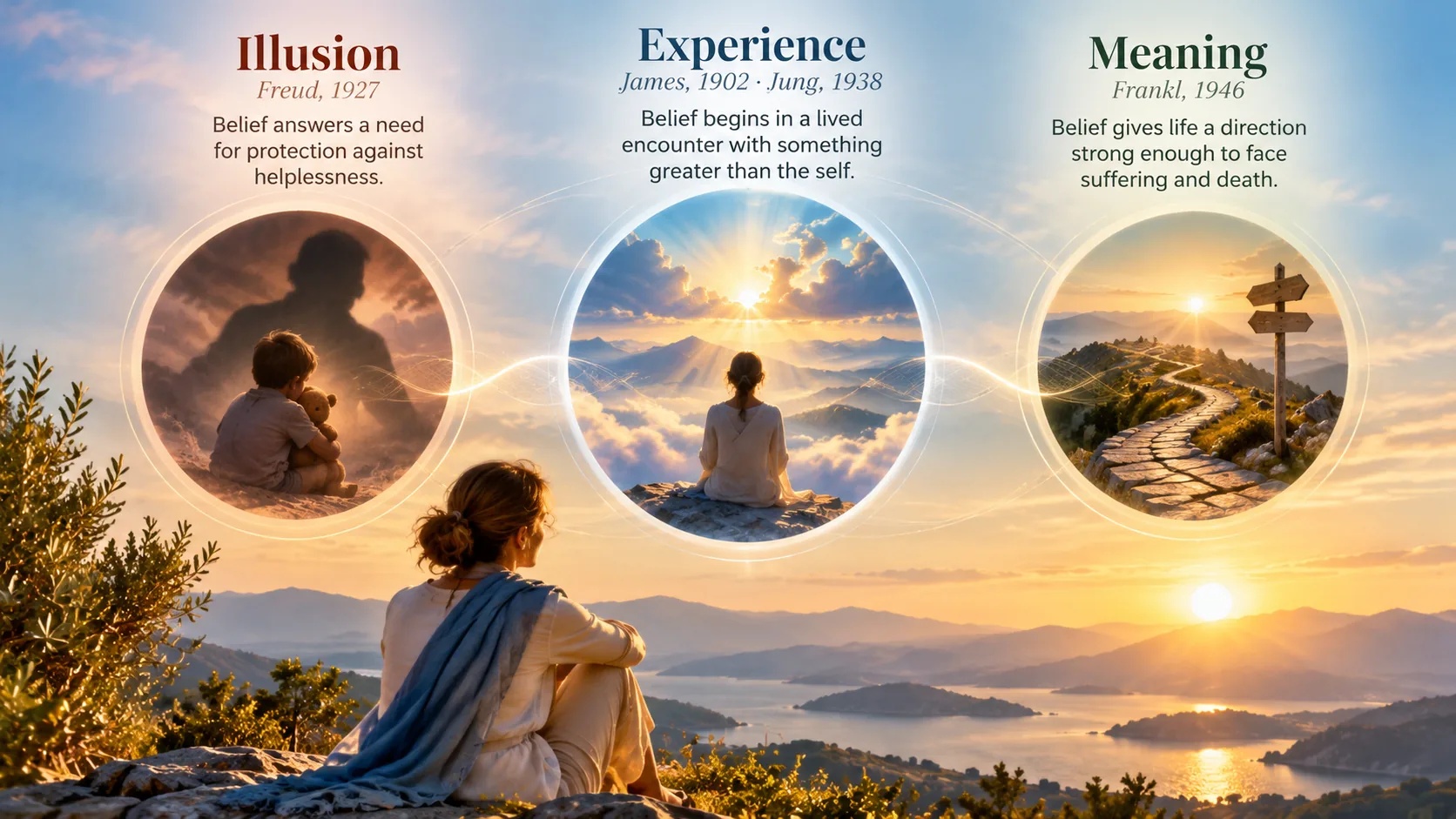
What Is the Psychology of Religion?
The psychology of religion studies belief from the inside: not whether it is true, but what it does in a human life. Why do people believe? Is faith an illusion, an experience or a way of making meaning? And what does research say about belief in hard times?
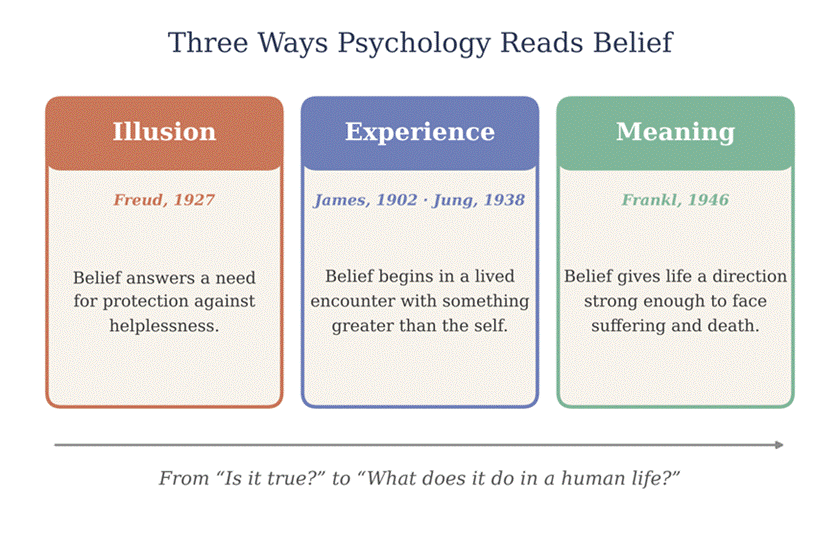
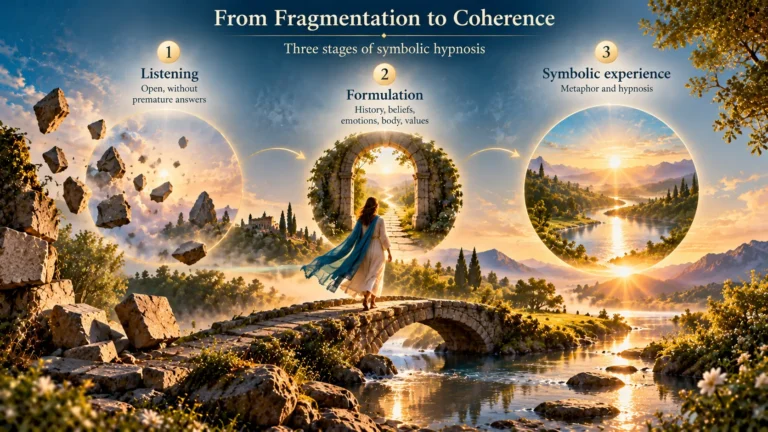
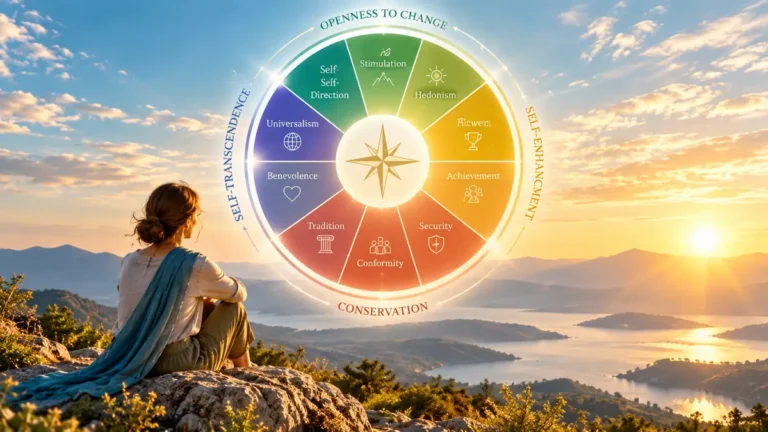
Symbolically, the three readings move from judging belief to understanding what it does for the person who holds it.
The psychology of religion is one of the fields of the Consciousness & Psychology door, at the crossroads of psychology, religious studies and philosophy. It looks at prayer, conversion, ritual, mystical experience and doubt as human experiences that can be described and understood.
From the start, it adopted a rule of method. The Swiss psychologist Théodore Flournoy called it the exclusion of the transcendent: the psychologist neither affirms nor denies the existence of God, and studies only what belief does in the mind and in life. This rule leaves the question of truth to each person, and opens a space where believers, seekers and sceptics can meet.
Understanding our beliefs helps us know ourselves: what they protect us from, and what they open us to. It also helps us understand a world where belief still moves individuals and nations. Let us look at the psychology of religion from five angles.
Where does the psychology of religion come from?
Its roots lie in an unexpected place: the séance rooms of the nineteenth century. In 1848, two sisters in upstate New York claimed to communicate with a spirit by knocking, and the Spiritualist movement spread across America and Europe. In 1882, scholars in Cambridge founded the Society for Psychical Research to study these phenomena with scientific methods; the American branch followed in 1885, with William James among its founders.
The classicist Frederic Myers proposed that beneath ordinary awareness lies a “subliminal self,” the source of both creative inspiration and strange phenomena. James built on this idea in The Varieties of Religious Experience (1902), the founding book of the field. He spent years observing the Boston medium Leonora Piper and remained convinced she was no fraud. Then two opposite answers emerged: Sigmund Freud’s critique in 1927, and Carl Jung’s lectures at Yale in 1937.
What are the three great readings of belief?
For Freud, religion is an illusion born of desire: the adult, still helpless before illness, chance and death, projects onto the universe the protective father of childhood. For James and Jung, religion begins with experience. Jung spoke of the numinous, an encounter with something that overwhelms and transforms the person. For him, creeds and dogmas are the later, fixed forms of an original experience.
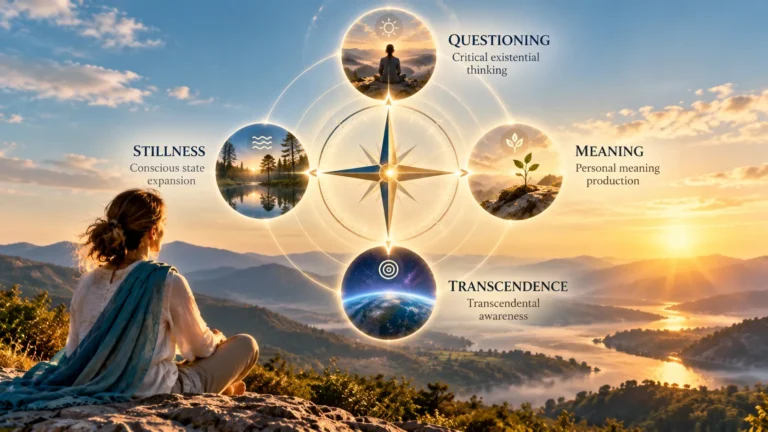
Symbolically, the third reading looks at what belief allows us to do. The psychiatrist Viktor Frankl, who survived the concentration camps, observed that those who had a reason to live held on longer. Belief here is a way of giving direction to a life, whatever its object.
What does belief teach us about suffering and meaning?
One reading, proposed by Elizabeth Carrio, replaces the word “illusion” with “construction.” An illusion distorts reality; a construction answers a question that existence asks without ever answering it: we are born, we suffer and we die. Faith is one answer. Money, success, family or nation can play exactly the same protective role. This is an interpretation, not an experimental result.
Consider Marc, who gave his life to his company. When he retires, he discovers that his work was more than a job: it was the structure that gave his days meaning. His crisis is, in this sense, close to a crisis of faith. Seen this way, every construction of meaning can heal or harm. The task is not to judge it true or false, but to see whether it is rigid and inherited, or chosen and still alive.
This reading continues a line of thought shared by existential psychology and transpersonal psychology.
What do the wisdom traditions add to this picture?
Jung’s method of amplification compared the images his patients produced with those of the traditions, from alchemy to Gnosis. The same symbols appeared in people who had never studied them. He concluded that a collective unconscious, shared by all humanity, lies beneath personal history.
Elizabeth Carrio extends this intuition with a hypothesis in two layers. The personal unconscious holds what our history has not yet brought to awareness. A deeper layer would be a field of information shared by all humanity, which each person shapes through their own language, culture and story. The systems theorist Ervin Laszlo called such a field the “Akashic field” (from the Sanskrit word for space) in 2004. This remains a hypothesis: it is debated and marginal in academic physics, and quantum physics does not prove it. At most, it offers a language for what Jung called the numinous.
In the language of symbolism, a symbol is a door to enter rather than a fact to accept or reject. The traditions also warn against using spiritual practice to avoid real difficulties, a trap that the psychologist John Welwood named “spiritual bypassing” in 1984.
What does modern research say about religion and psychology?
Research on religious coping has found that the way people use their faith matters more than how often they pray or attend services. Seeking support from a community and finding a benevolent meaning in hardship are linked with better adjustment. Seeing oneself as punished or abandoned by God is linked with more distress (Pargament, Koenig and Perez, 2000). These are associations, not proof that faith causes well-being.
The landscape of belief is also changing. In a 2023 survey, Pew Research Center found that 22% of American adults describe themselves as spiritual but not religious. Jung had foreseen this: modern people were losing the traditional forms of religion without losing the inner need they answered.
In a nutshell
The psychology of religion studies what belief does in a human life, without deciding whether it is true. It reads faith as a need, an experience or a construction of meaning. Every construction can heal or harm, and understanding our own beliefs is a path to knowing ourselves.
Practice: Your Map of Meaning (10 minutes)
Take a sheet of paper and answer in writing.
- List what helps you stand when life is hard: a faith, people, work, nature, a cause.
- For each one, note what it protects you from, and what it opens you to.
- Recall a difficult period of your life. Which of these held, and which gave way?
- Ask yourself: which of my sources of meaning did I inherit without choosing, and which have I truly made my own?
This is a reflective exercise, not therapy.
Quote
“Our normal waking consciousness… is but one special type of consciousness.” — William James, The Varieties of Religious Experience, 1902
Sources
- James, W., The Varieties of Religious Experience, Longmans, Green and Co., 1902.
- Freud, S., The Future of an Illusion, 1927.
- Jung, C. G., Psychology and Religion, Yale University Press, 1938.
- Frankl, V. E., Man’s Search for Meaning, Beacon Press, 1959 (first published in German, 1946).
- Pargament, K. I., Koenig, H. G., and Perez, L. M., The Many Methods of Religious Coping, Journal of Clinical Psychology, 2000.
Go deeper
The Awakening Journal — a free reflective workbook to deepen your spiritual intelligence.
Related articles
- What is Consciousness? (Consciousness & Psychology)
- Existential Psychology: Meeting the Great Questions of Life (Consciousness & Psychology)
- What Is Tarot? (Wisdom & Spirituality)
By Elizabeth Carrio, MSc in Consciousness and Transpersonal Psychology · Published October 17, 2026 · Last updated October 17, 2026 · Disclaimer